
Product Video Ads: How to Create Videos That Convert

Modest Mitkus
June 2, 2026
Product video ads have become the cornerstone of digital marketing in 2026, with brands seeing conversion rates that eclipse traditional image-based advertising by significant margins. Whether you're scrolling through TikTok, browsing Instagram Reels, or shopping on Amazon, video content dominates the landscape because it captures attention, builds trust, and drives action faster than any other format. The challenge? Creating enough high-quality product video ads to keep up with the demand for fresh creative across multiple platforms and audience segments.
Why Product Video Ads Outperform Static Content
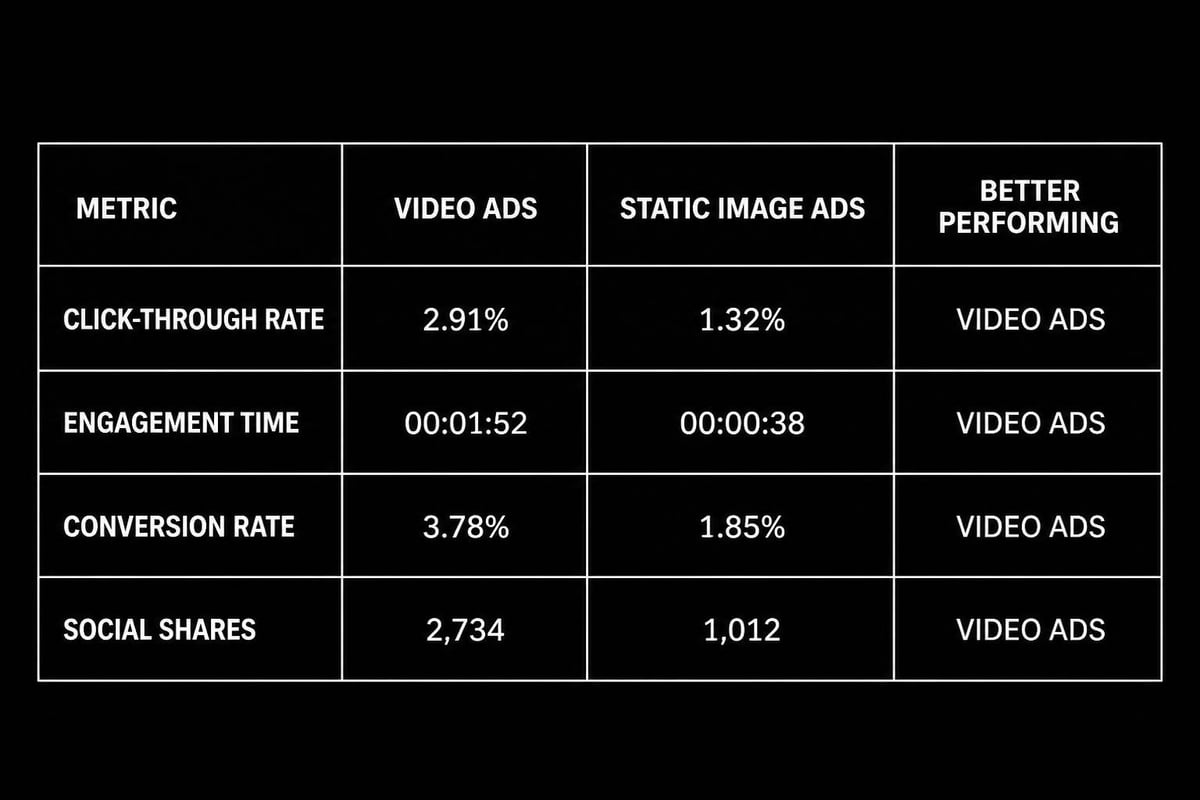
The data doesn't lie. Product video ads consistently outperform static images across every meaningful metric marketers care about. But why?
Video engages multiple senses simultaneously. When viewers watch a product in action, they process visual movement, audio narration, music, and text overlays all at once. This multisensory experience creates stronger memory encoding than a single image ever could.
Consider these performance indicators:
- Click-through rates average 2-3x higher for video ads compared to static image ads
- Time on page increases by 88% when product videos appear on landing pages
- Purchase confidence jumps when customers can see products demonstrated in real-world contexts
- Social sharing happens 12x more frequently with video content than with images and text combined
The psychology behind this performance boost is straightforward. Videos reduce uncertainty. When someone sees your skincare product applied to actual skin, or your gadget solving a real problem, they don't have to imagine how it works. They see it working.
The Trust Factor
Product video ads build credibility in ways that feel organic rather than promotional. According to research on effective product demo best practices, videos that show real people using products generate significantly higher trust scores than polished studio shots.
This authenticity gap explains why UGC-style content has exploded in popularity. Consumers in 2026 are sophisticated. They can spot overly produced corporate content from a mile away, and they're much more likely to trust content that feels genuine.
Essential Formats for Product Video Ads
Not all product video ads serve the same purpose. Your creative strategy should include several formats, each optimized for different stages of the customer journey.
The Product Showcase
Length: 6-15 seconds
Purpose: Grab attention and highlight key features
Best for: Top-of-funnel awareness campaigns
Product showcase videos are your digital storefront. They need to communicate value instantly. Think of them as your elevator pitch in visual form.
| Element | Best Practice | Why It Matters |
|---|---|---|
| Opening hook | Lead with the transformation or benefit | You have 1.5 seconds before users scroll |
| Product visibility | Show the product within first 2 seconds | Viewers need immediate context |
| Text overlays | Keep it to 3-5 words maximum | Too much text kills retention |
| Call-to-action | End with clear next step | Confusion kills conversions |
The Demonstration Video
These longer-form product video ads (15-45 seconds) walk viewers through how your product solves a specific problem. Amazon's creative best practices for video ads emphasize showing products in action rather than just talking about features.
Demonstration videos should answer:
- What problem does this solve?
- How does the product work?
- What makes this solution better than alternatives?
- What happens after someone buys?
The power of demonstration lies in removing friction from the buying decision. When customers can visualize themselves using your product successfully, objections melt away.
UGC-Style Testimonials
Perhaps the most powerful format in 2026, user-generated content (or content that looks like UGC) drives exceptional performance because it doesn't feel like advertising at all.
Real customers sharing authentic experiences create social proof that polished brand videos simply cannot match. The challenge has always been generating enough UGC video content to test different angles, hooks, and messaging variations.
Creating High-Converting Product Video Ads
The mechanics of creating effective product video ads have evolved dramatically. What worked in 2023 feels dated now. Today's top performers follow specific structural principles.
Hook Formulas That Stop the Scroll
Your first 1-3 seconds determine everything. Here are the hook frameworks driving the highest retention rates in 2026:
- Pattern interrupt: "Stop using [common solution]..."
- Surprising statistic: "87% of people don't know this about..."
- Relatable problem: "Ever notice how [frustrating situation]..."
- Direct benefit: "Here's how to [desired outcome] in [timeframe]..."
- Curiosity gap: "The real reason your [product category] isn't working..."
Test at least 5-7 different hooks for each product. The hook that resonates with your audience won't always be the one you expect.
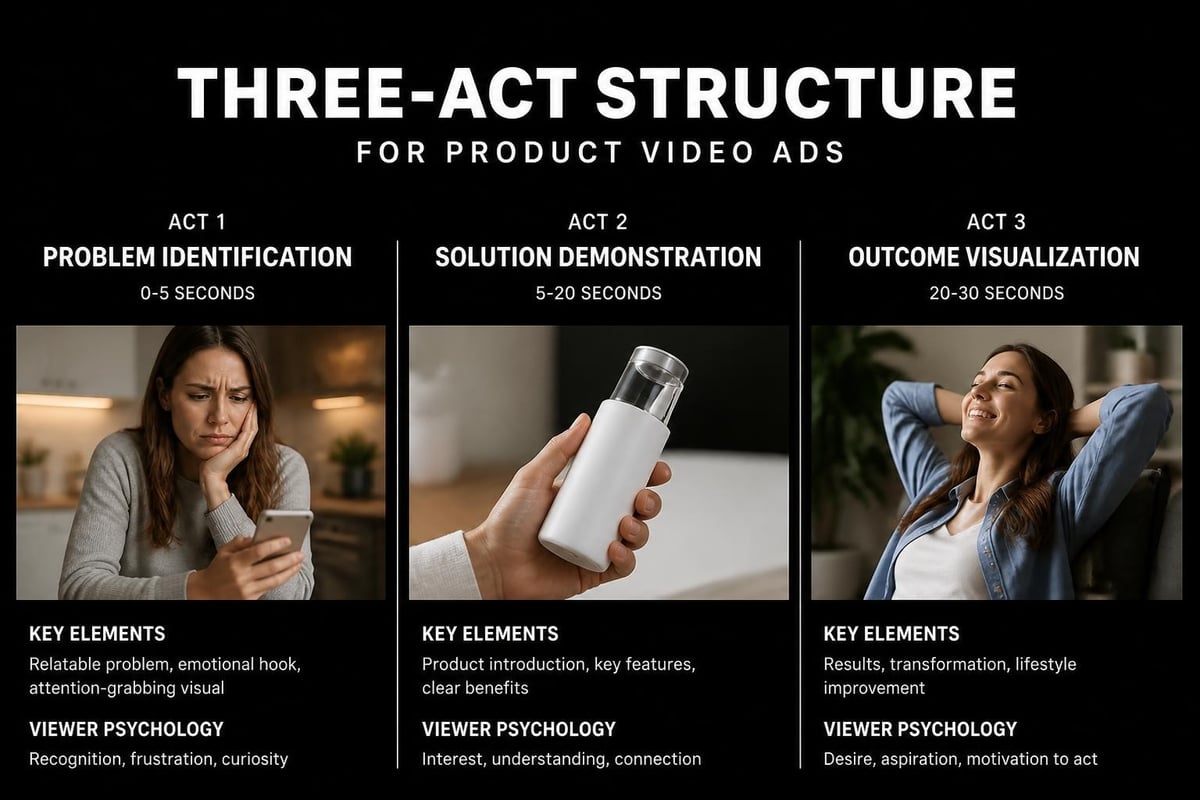
The Three-Act Structure
Following proven product video best practices, structure your product video ads like mini-stories:
Act 1 - The Problem (3-5 seconds)
Establish the pain point your audience experiences. Make it specific and relatable.
Act 2 - The Solution (8-15 seconds)
Introduce your product as the answer. Show it in action, demonstrate key features, highlight what makes it different.
Act 3 - The Outcome (3-5 seconds)
Paint the picture of life after purchase. What transformation occurs? End with a clear call-to-action.
This narrative flow feels natural to viewers because it mirrors how we process stories. It doesn't feel like a sales pitch even though it's driving toward a conversion.
Technical Specifications That Matter
Platform requirements shift constantly, but these specs remain critical across Facebook, Instagram, TikTok, and YouTube in 2026:
| Specification | Optimal Setting | Rationale |
|---|---|---|
| Aspect ratio | 9:16 (vertical) | Native mobile experience, maximum screen real estate |
| Resolution | 1080x1920 minimum | Quality threshold for professional appearance |
| Frame rate | 30 fps | Balance between smooth motion and file size |
| Audio | Stereo with voiceover | Accommodates both sound-on and sound-off viewing |
| Captions | Burned-in subtitles | 85% of video ads play without sound |
| Duration | 15-30 seconds | Sweet spot for retention and message completion |
Don't sleep on captions. They're not optional anymore. The majority of viewers watch product video ads on mute while scrolling in public spaces, during meetings, or in bed next to sleeping partners.
Scaling Your Product Video Ad Production
Here's the dirty secret about product video ads in 2026: you need way more creative than you think.
Top-performing brands aren't running one or two video ads. They're testing 20, 30, sometimes 50+ variations simultaneously. Different hooks, different actors, different angles on the same product. This volume-based approach to creative testing has become the standard because ad fatigue happens faster than ever.
The Traditional Production Bottleneck
The old way of creating product video ads looked like this:
- Brief a creative team or hire a creator
- Wait 1-2 weeks for scripts and concepts
- Schedule a shoot (another 1-2 weeks)
- Wait for editing and revisions (1+ week)
- Finally launch your ads (4-6 weeks total)
By the time your video goes live, your competitor has already tested five variations and optimized to the winner.
The math doesn't work. If you're spending $400-800 per video and testing requires 20+ variations, you're looking at $8,000-16,000 just to get started. Then when something doesn't perform, you're back to square one, waiting weeks for reshoots.
The AI-Powered Alternative
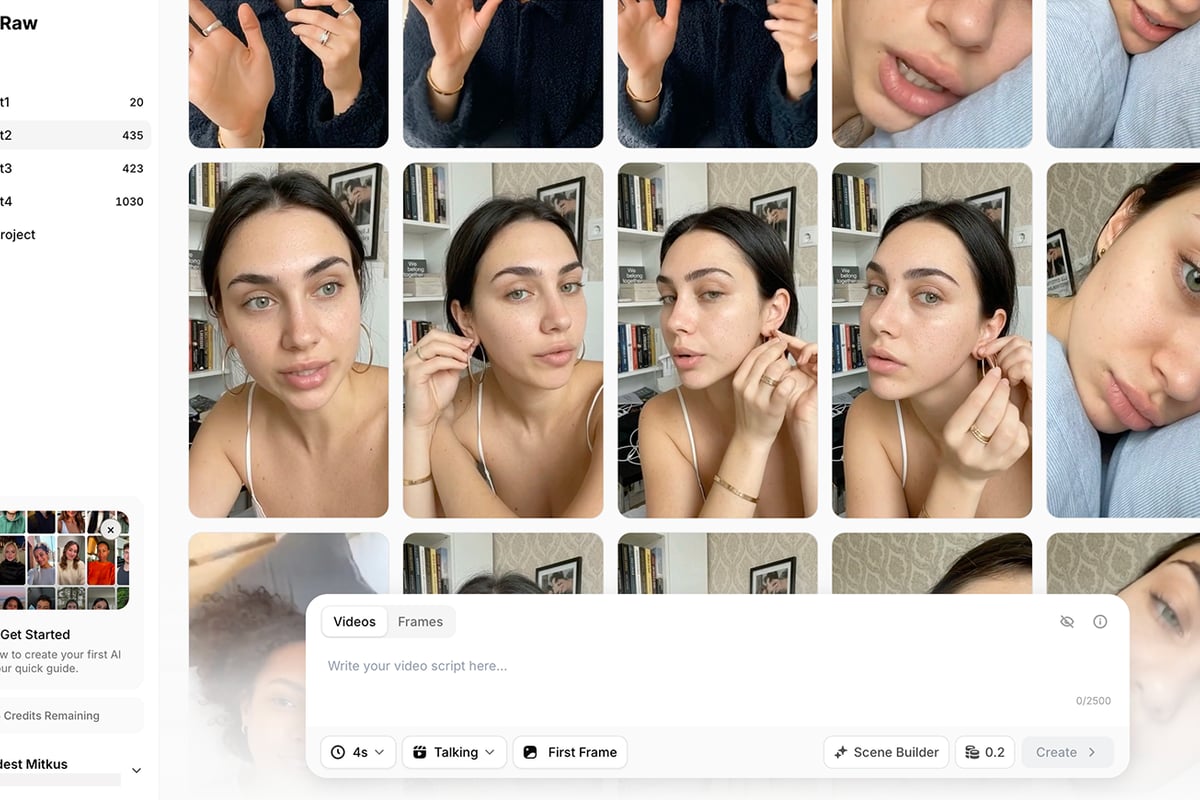
Modern performance marketers are turning to AI-powered solutions that generate product video ads in minutes instead of weeks. By using platforms like AdsRaw's AI Product Video Generator, brands can create dozens of variations quickly and affordably, testing different scripts, actors, and approaches without the traditional production timeline or costs.
The beauty of this approach is velocity. When you can generate a new video variation in 10 minutes instead of 10 days, you can respond to performance data in real-time. Your best-performing hook from Monday's tests can inform Tuesday's creative batch.
Platform-Specific Optimization Strategies
Different platforms demand different approaches to product video ads. What crushes on TikTok might flop on Facebook. Understanding these nuances separates amateur campaigns from professional results.
TikTok and Instagram Reels
These platforms reward raw, authentic-feeling content over polished production. Your product video ads should look native to the platform.
Key optimization tactics:
- Start with a relatable, conversational hook
- Use trending sounds when relevant (but not forced)
- Keep product front-and-center but make it feel casual
- Encourage engagement through questions or challenges
- Post consistently (algorithm rewards frequency)
The performance data on UGC-style ads shows that videos featuring real people (or realistic AI actors) outperform slick brand videos by 3-4x on these platforms.
Facebook and Instagram Feed
These placements allow for slightly longer, more detailed product video ads. Your audience here is often further along in their research phase.
Consider including:
- More detailed product information
- Customer testimonials or reviews
- Before/after demonstrations
- Specific pricing or promotion details
- Stronger direct response CTAs
YouTube Shorts and Pre-Roll
YouTube viewers are in a different mindset. They're often actively searching for solutions or researching purchases.
Your product video ads here should:
- Acknowledge the viewer's search intent
- Position your product as the solution
- Provide educational value, not just promotion
- Include clear next steps with clickable elements
The case study on video ad performance demonstrates how targeted video advertising on platforms like YouTube can drive 8x return on ad spend when properly optimized.
Testing and Optimization Framework
Creating product video ads is only half the battle. Systematic testing separates winners from losers.
Variables Worth Testing
Don't test everything at once. Isolate specific variables so you can identify what actually drives performance improvements:
Creative variables:
- Hook variations (different opening lines or visuals)
- Actor demographics (age, gender, ethnicity)
- Product positioning (features vs. benefits)
- Video length (15s vs. 30s vs. 45s)
- Background settings (home vs. studio vs. outdoor)
Technical variables:
- Thumbnail images
- Caption copy
- CTA placement and wording
- Music selection
- Color grading and filters
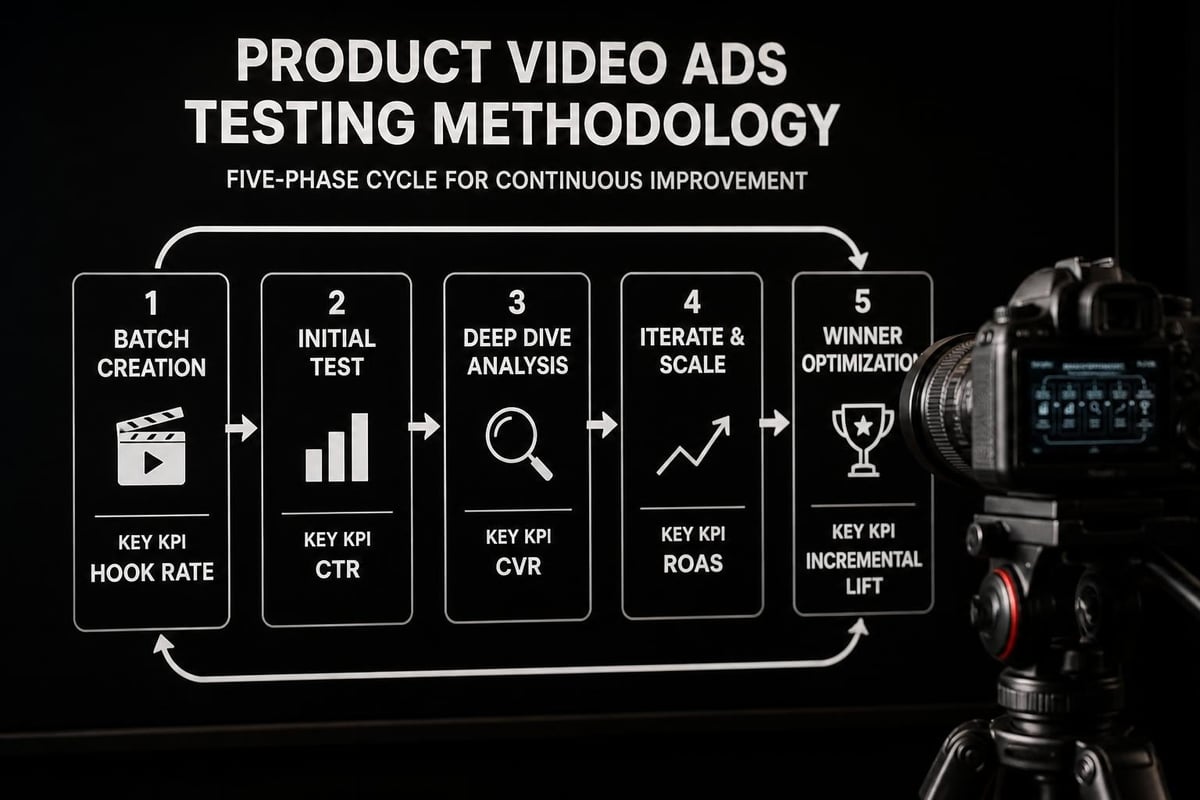
The Testing Cycle
Run each test for at least 3-5 days to gather meaningful data. Here's the systematic approach used by top direct-to-consumer brands:
| Phase | Action | Timeline | Success Metric |
|---|---|---|---|
| 1. Batch Creation | Generate 10-15 variations | Day 1 | Volume of unique creatives |
| 2. Initial Launch | Equal budget to all variants | Days 2-4 | CTR and hook retention |
| 3. First Cut | Kill bottom 50% performers | Day 5 | Statistical significance |
| 4. Scale Testing | Increase budget on top 3-5 | Days 6-10 | CPA and ROAS |
| 5. Winner Optimization | Iterate on top performer | Days 11+ | Sustained performance |
This systematic approach to testing video ad creative ensures you're always improving rather than just guessing what might work.
Reading the Data Correctly
Not all metrics matter equally. Focus on these indicators:
Early signals (first 48 hours):
- Hook rate (3-second video view percentage)
- Thumb-stop rate (initial engagement)
- Click-through rate
Mid-stage signals (days 3-7):
- Cost per click
- Add-to-cart rate
- Video completion rate
Final performance metrics (week 2+):
- Cost per acquisition
- Return on ad spend
- Customer lifetime value
A product video ad might have a lower CTR but drive higher-quality traffic that converts better. Don't optimize for the wrong metrics.
Common Mistakes That Kill Performance
Even experienced marketers make these critical errors with product video ads.
Mistake #1: Leading with Your Brand
Nobody cares about your brand in the first three seconds. They care about their problems and desires. Lead with benefits, not brand identity.
Bad opening: "Welcome to XYZ Brand, where we've been making quality products since 2020..."
Good opening: "This is why your skin looks dull by 2 PM..."
Mistake #2: Overproduced Aesthetics
That perfectly lit, professionally shot video might win awards, but it probably won't win customers on social platforms. Research from studies on e-commerce video ads shows that authentic-looking content consistently outperforms overly polished corporate videos.
Mistake #3: Forgetting Sound-Off Viewing
If your product video ads don't make sense without audio, you're losing 75-85% of potential viewers. Every video needs burned-in captions, visual demonstrations, and text overlays that communicate the message completely.
Mistake #4: Weak or Missing CTAs
"Learn more" is not a call-to-action. It's a vague suggestion. Tell viewers exactly what to do next:
- "Tap to get 20% off your first order"
- "Click to see if we ship to your area"
- "Swipe up to take the skin quiz"
- "Comment 'READY' for the link"
Specificity drives action. Vagueness drives scrolling.
Mistake #5: Creating Once and Forgetting
The winning product video ad today will be fatigued in 2-4 weeks. Performance marketers treat creative as a continuous process, not a one-time project. Your creative library should grow every single week.
Examples of successful user-generated content show that brands constantly refreshing their creative maintain consistent performance while competitors experience declining returns.
Advanced Strategies for 2026
The cutting edge of product video ads involves techniques that weren't even possible two years ago.
Dynamic Creative Optimization
Instead of creating one video and showing it to everyone, advanced campaigns serve personalized variations based on:
- Viewer demographics
- Previous browsing behavior
- Device type
- Time of day
- Geographic location
A viewer in Florida might see your product demonstrated at the beach, while someone in Colorado sees a mountain setting. Same product, contextually relevant presentation.
Sequential Storytelling
Rather than trying to tell the complete story in one video, sophisticated campaigns use sequences:
Video 1 (awareness): Introduce the problem
Video 2 (consideration): Show the solution
Video 3 (conversion): Address objections and drive purchase
Users who engage with Video 1 get retargeted with Video 2, creating a narrative journey that builds trust over time. This approach mirrors effective video ad storyline strategies that enhance viewer engagement through structured narratives.
Shoppable Video Integration
The line between content and commerce continues blurring. Shoppable video ads allow viewers to purchase products without ever leaving the video player, reducing friction and dramatically improving conversion rates.
In 2026, the most sophisticated product video ads include:
- Clickable product tags within the video
- Instant checkout options
- AR preview capabilities
- Live inventory updates
- One-click reordering for consumables
AI Actors and Synthetic Media
Perhaps the most transformative development in product video ads is the rise of realistic AI-generated content. Using AI actors allows brands to create dozens of variations with different presenters, demographics, and styles without coordinating multiple creator schedules or budgets.
This technology has matured to the point where synthetic media is virtually indistinguishable from traditionally filmed content, opening up possibilities for hyper-personalization at scale.
Budget Allocation and ROI Expectations
How much should you invest in product video ads, and what returns should you expect?
Startup and Small Business Budgets
Monthly ad spend: $2,000-10,000
Creative production: $500-2,000/month
Expected ROAS: 2-4x in months 1-3, scaling to 4-6x by month 6
At this level, focus on learning. Generate multiple variations quickly, identify what resonates with your audience, then double down on winners.
Mid-Market Brands
Monthly ad spend: $10,000-100,000
Creative production: $2,000-8,000/month
Expected ROAS: 4-6x sustained
You need consistent creative refreshment at this scale. Plan to test 20-40 new product video ad variations monthly across different products, audiences, and platforms.
Enterprise Campaigns
Monthly ad spend: $100,000+
Creative production: $10,000-30,000/month
Expected ROAS: 5-8x with sophisticated attribution
At enterprise scale, creative operations become their own department. Systematic testing, rapid iteration, and platform-specific optimization are non-negotiable.
Future-Proofing Your Video Strategy
The landscape of product video ads will continue evolving rapidly. Position yourself for future success by:
Investing in owned creative capabilities. Whether through in-house teams or AI-powered platforms, reducing dependency on external agencies increases agility and decreases costs over time.
Building creative libraries. Every video you create is an asset. Catalog, tag, and organize your creative so you can repurpose elements and learn from past performance.
Staying platform-agnostic. Don't build your entire strategy around one platform's algorithm. What works on TikTok today might work on an emerging platform tomorrow.
Prioritizing data infrastructure. The brands winning with product video ads in 2026 have sophisticated attribution models that track viewer journeys across platforms and touchpoints.
Testing emerging formats early. When new platforms or ad formats emerge, early adopters get lower CPMs and higher organic reach while competition is still low.
The brands treating product video ads as a core competency rather than a marketing tactic are the ones building sustainable competitive advantages in the attention economy.
Product video ads have evolved from a nice-to-have into the primary driver of e-commerce growth, but creating enough high-quality variations to stay competitive remains the biggest challenge for most brands. The traditional production model simply can't keep pace with the volume modern performance marketing demands. AdsRaw solves this bottleneck by letting you generate realistic UGC-style product video ads in minutes instead of weeks, giving you the creative velocity to test rapidly, optimize continuously, and scale what works without the traditional costs or timeline constraints.