
AI Video from Script: Create High-Converting Ads in Minutes

Modest Mitkus
May 31, 2026
The advertising world has shifted dramatically. What once required weeks of coordination, expensive creator fees, and multiple revision rounds can now happen in minutes. AI video from script technology has become the secret weapon for brands that need to test creative concepts fast, iterate based on performance data, and scale winning campaigns without burning through their production budget. If you're still waiting on traditional video production timelines while your competitors are launching dozens of ad variations weekly, you're already behind.
The Evolution of Script-to-Video Technology
Remember when turning a script into a video meant hiring actors, booking studios, coordinating schedules, and hoping everything aligned? Those days feel like ancient history now.
The transformation started with basic templated video tools that let you add text to stock footage. Functional, but nothing special. Then came the first wave of AI narration tools that could read your script aloud over slides. Better, but still far from the engaging content that actually stops scrollers mid-feed.
Modern AI video from script platforms have changed everything:
- Natural-sounding voice synthesis that matches emotion to context
- Realistic AI actors who can deliver your script with appropriate facial expressions
- Automated scene generation based on script content
- Multiple style options from professional presentations to casual UGC content
- Instant revision capabilities without reshoots
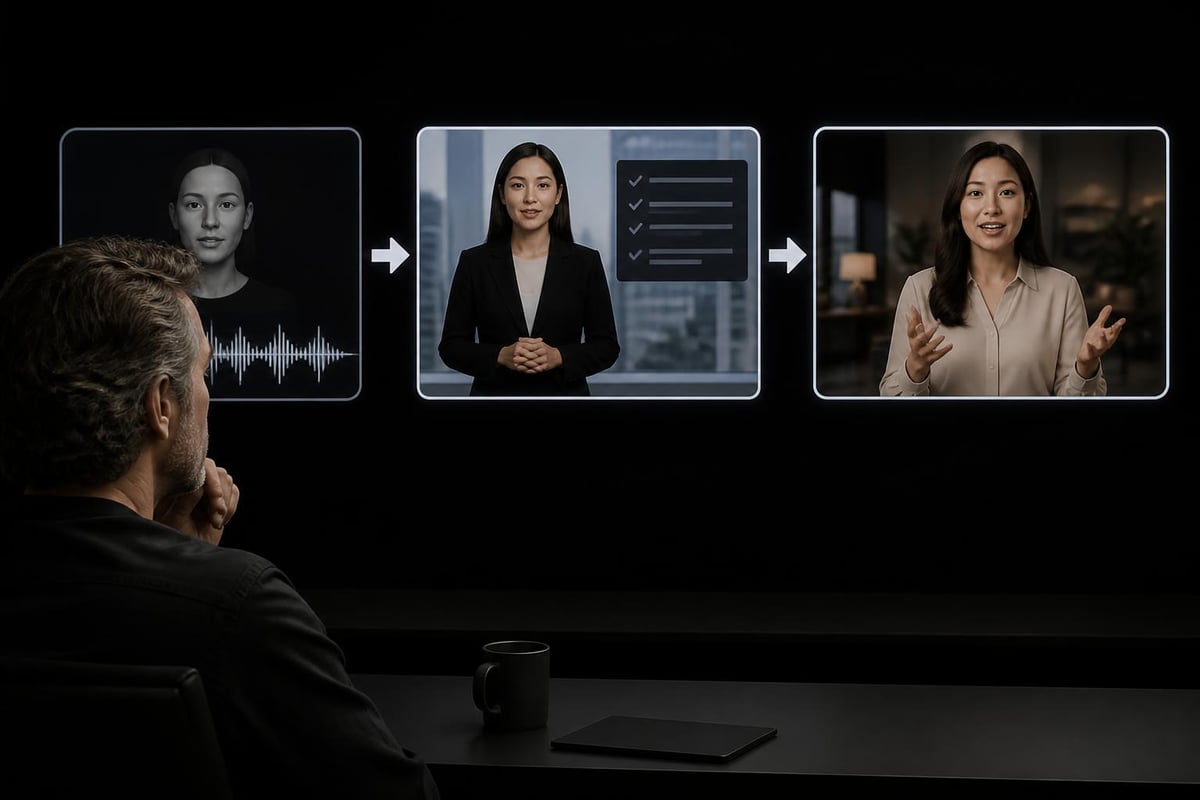
Research shows that AI-driven video generation techniques have advanced rapidly, with text-to-video generators now capable of producing content that rivals traditional production methods in specific use cases. For advertisers, this means the barrier between idea and execution has essentially disappeared.
Why Traditional Video Production Can't Keep Up
The old model breaks down when you need speed. You write a script, wait for creator availability, schedule a shoot, film multiple takes, review footage, request edits, and finally receive your video. Two weeks later, you're uploading your first test ad. By then, your competitor has tested twenty variations and already found their winner.
Here's what kills momentum in traditional workflows:
- Creator availability constraints limit when you can shoot
- Location and equipment logistics add complexity
- Post-production timelines extend delivery dates
- Revision costs discourage testing multiple angles
- Geographic limitations restrict talent access
The math doesn't work anymore. If you're spending $400+ per creator video and testing needs twenty variations to find a winner, that's $8,000 before you know what performs. Most brands can't sustain that burn rate, especially when platforms like TikTok and Meta reward fresh creative with better distribution.
How AI Video from Script Actually Works
The technology sounds like magic, but understanding the mechanics helps you use it more effectively. When you input a script into an AI video generator, several sophisticated processes happen simultaneously.
| Process Stage | What Happens | Why It Matters |
|---|---|---|
| Script Analysis | AI parses text for tone, emotion, pacing | Ensures natural delivery |
| Actor Selection | System matches voice/appearance to content | Maintains brand consistency |
| Scene Generation | Visual context created from script cues | Enhances message clarity |
| Synthesis | Voice, facial movements, and visuals combine | Creates cohesive final product |
The neural networks powering these systems have been trained on massive datasets of human speech patterns, facial expressions, and body language. They don't just read words mechanically. They understand context. When your script says "I couldn't believe how fast it worked," the AI actor's face shows genuine surprise. When you write "This changed everything for me," the delivery conveys authentic enthusiasm.
The Technical Breakthrough Behind Realistic Results
What separates today's AI video from script tools from earlier attempts? The answer lies in diffusion models and transformer architectures that can generate video frame by frame while maintaining temporal coherence. Translation: your AI actor doesn't glitch between frames or lose lip sync halfway through.
Recent developments in video generation models demonstrate how commercial-level quality now rivals professional production in certain contexts, particularly for short-form advertising content where authenticity matters more than Hollywood-grade cinematography.
Think about what UGC-style content actually requires. It's not perfect lighting or flawless makeup. It's someone who looks real, sounds real, and delivers a message that feels like a genuine recommendation rather than a scripted advertisement. AI video from script technology excels at creating exactly this type of content.
Writing Scripts That Work With AI Video Generators
Not every script translates equally well to AI video. Understanding how to structure your writing for AI actors maximizes the quality of your output and minimizes revision rounds.
Core principles for AI-optimized scripts:
- Write how people actually talk, not how they write
- Include natural pauses and conversational fillers
- Break long sentences into shorter, punchier statements
- Specify emotional tone when it's not obvious from context
- Front-load your hook in the first three seconds
Your opening line determines whether viewers keep watching or scroll past. "Hey, so I tried this new skincare routine" performs better than "I want to tell you about an innovative dermatological solution." AI actors deliver both, but the first one sounds like your friend texting you, while the second sounds like a press release.
The Anatomy of a High-Converting UGC Script
Let's break down what actually works in the wild. When you're creating UGC video content with AI, structure matters as much as the words themselves.
Effective script structure:
- Pattern interrupt (0-3 seconds): Stop the scroll
- Problem identification (3-8 seconds): "You know that annoying thing?"
- Solution introduction (8-15 seconds): Present your product naturally
- Proof point (15-25 seconds): Specific result or feature
- Call to action (25-30 seconds): Tell them what to do next
Notice what's missing? Corporate jargon. Excessive qualifiers. Long explanations. The best AI video from script results come from scripts that sound like a conversation you'd have with someone who genuinely loves a product, not a salesperson reading bullet points.
When you're creating video with AI, test variations of your hook aggressively. Change just the first sentence and keep everything else identical. You'll often find that a slight phrasing shift doubles your hook rate because it better matches how your audience actually communicates.
Choosing the Right AI Actors for Your Brand
Your script is only half the equation. The person delivering it matters enormously. Different AI actors convey different levels of authority, relatability, and trustworthiness based on their appearance, age, accent, and delivery style.
Think strategically about actor selection. A financial services ad might perform better with an older actor who conveys experience and stability. A gaming peripheral benefits from someone who looks like they actually play games. Skincare often converts best when the actor's apparent age matches your target demographic.
Matching Actors to Audience Psychographics
Demographics tell you who your customers are, but psychographics tell you how they think. When you select AI actors for your video content, consider:
- Energy level: Does your audience respond to enthusiasm or calm expertise?
- Formality: Professional delivery versus casual friend-to-friend recommendation?
- Accent and regionality: Do local accents increase trust for your market?
- Visual style: Polished and put-together versus authentic and unfiltered?
The beauty of AI video from script workflows is you can test these variables systematically. Create five versions of the same script with different actors and let your ad platform tell you which one your audience prefers. This kind of testing was prohibitively expensive with traditional creator partnerships.
Platforms like Stijl en Vorm understand the strategic importance of matching creative execution to audience preferences, especially when building comprehensive digital campaigns where video content integrates with broader marketing initiatives.
Rapid Testing and Iteration Strategies
Here's where AI video from script technology becomes truly transformative. The ability to generate variations isn't just convenient, it's a competitive advantage that compounds over time.
Traditional video testing meant picking your best guess, shooting it, running it, and hoping it worked. If it didn't, you were looking at another production cycle before you could test again. By the time your second variation launched, the campaign window might have closed or your budget depleted.
AI-powered workflows flip this model entirely. You can now:
- Test 10+ script variations in the time it previously took to produce one video
- Iterate based on performance data within hours instead of weeks
- Personalize content for different audience segments without multiplying costs
- Respond to trending topics while they're still relevant
- Scale winning concepts across multiple platforms simultaneously
| Testing Approach | Traditional Production | AI Video from Script |
|---|---|---|
| Variations per week | 1-2 | 20+ |
| Cost per variation | $400-800 | Marginal |
| Revision turnaround | 3-7 days | Minutes |
| Personalization feasibility | Low | High |
The data compounds. Each test teaches you something about your audience's preferences. After running fifty script variations, you understand exactly which hooks, pain points, and calls to action resonate. You've built a knowledge base that informs every future creative decision.
The Performance Marketing Advantage
Performance marketers live and die by their ability to find winning creative quickly. Every day you spend testing is a day your competitors might find the angle that works. AI video from script technology compresses the learning cycle dramatically.
Ryan Cook and similar specialists in ad creation understand that the real skill isn't in creating one great ad, it's in creating the system that reliably produces great ads at scale. When you can generate twenty script variations, test them simultaneously, identify the top three performers, and scale those within 48 hours, you've achieved something traditional workflows can't match.
Integration with Advertising Platforms
Creating videos is one thing. Getting them to perform in actual advertising campaigns is another. The best AI video from script platforms understand the technical requirements and best practices for major advertising channels.
Platform-specific considerations:
- Meta/Instagram: Square or vertical formats, captions essential, hook in first 2 seconds
- TikTok: Authentic, unpolished aesthetic performs best, leverage trending sounds
- YouTube: Longer watch time possible, can include more detailed explanations
- LinkedIn: Professional tone, focus on business outcomes and ROI
- Twitter/X: Quick-hitting messages, designed for sound-off viewing
Each platform has its own culture and content expectations. A script that crushes on TikTok might feel out of place on LinkedIn. The advantage of rapid AI video generation is you can adapt the same core message to different platform contexts without starting from scratch each time.
Tools that let you quickly create UGC video content become particularly valuable when you're running omnichannel campaigns and need to maintain consistent messaging while respecting platform-specific norms.

Technical Specs That Actually Matter
Beyond creative considerations, your videos need to meet technical specifications or platforms will reject them. AI video from script generators typically handle these automatically, but it's worth understanding what matters:
- Resolution: 1080p minimum for most platforms, 4K increasingly preferred
- Aspect ratio: 9:16 for vertical, 1:1 for square, 16:9 for horizontal
- File size: Under platform limits (varies by channel)
- Frame rate: 30fps standard, 60fps for action content
- Audio quality: Clear narration without clipping or distortion
The technical reliability of modern AI generation means you're not spending time troubleshooting encoding issues or re-exporting files. You get platform-ready videos immediately, which removes another friction point from your workflow.
Real-World Applications Across Industries
AI video from script isn't just for one type of business. The technology adapts to virtually any industry that uses video advertising, though implementation strategies vary by vertical.
E-commerce brands use it to showcase products with authentic-feeling testimonials at scale. Instead of hiring twenty different creators to review your product line, you generate variations that test different angles, benefits, and use cases.
SaaS companies leverage AI video to explain complex features through clear, conversational narratives. The ability to update scripts as features evolve means your video content never becomes outdated.
Local service businesses create personalized video content for different neighborhoods or customer segments. A dental practice can generate multiple ads highlighting different services without coordinating multiple shoot days.
Agencies managing multiple clients use AI video from script to accelerate creative production while maintaining quality standards. The same team that could previously service five clients can now handle fifteen without compromising results.
Case Study: From Concept to Campaign
Consider a skincare brand launching a new product. Traditional approach: brief creators, wait for availability, coordinate shipment of product samples, wait for content, review submissions, negotiate revisions, finally receive usable videos three weeks later.
AI video from script approach: Write five script variations testing different angles (anti-aging, natural ingredients, fast results, luxury experience, value proposition). Generate videos with three different AI actors for each script (15 total variations). Launch all fifteen simultaneously with identical budgets. Identify top three performers after 48 hours. Scale winners, kill losers, create new variations based on learnings. Repeat cycle weekly.
One brand using this approach found their winning creative in the eleventh variation. Under traditional production constraints, they never would have gotten there. The cost and time required would have stopped them at variation three or four. AI video from script technology allowed them to push through until they found what actually converted.
When working with professional teams that understand both creative and performance aspects, like those specializing in UGC-style advertising, the results compound even faster because strategic expertise combines with technical capability.
Overcoming Common Misconceptions
Let's address the elephants in the room. AI video from script still carries misconceptions that prevent some brands from adopting it effectively.
"AI videos look fake and viewers can tell."
Early AI videos did look off. Uncanny valley territory. But technology has improved dramatically. Modern AI actors display natural micro-expressions, appropriate eye movements, and realistic speech patterns. In blind tests, viewers often can't reliably distinguish AI-generated UGC from creator-made content, especially in the short-form formats that dominate paid social.
"My audience will reject AI-generated content."
Your audience cares about three things: Does this content entertain me, inform me, or help me solve a problem? They're not running forensic analysis on whether the person speaking is AI-generated. They're evaluating whether the message resonates. Platforms like YouTube have already integrated AI video creation into their creator tools, signaling mainstream acceptance.
"AI can't capture my brand voice."
Your brand voice lives in your script. AI actors deliver what you write. If your scripts authentically reflect how your brand communicates, the AI delivery will too. The challenge isn't the technology limiting you, it's ensuring your written voice translates to spoken delivery.
What AI Video Actually Can't Do (Yet)
Transparency matters. AI video from script excels at certain applications and struggles with others. Understanding the limitations helps you deploy it effectively.
- Highly specific physical demonstrations requiring exact hand positions or detailed product interactions work better with human creators
- Content requiring genuine emotion from personal experience (like customer testimonials about life-changing products) still needs real people
- Complex choreography or precise physical movements remain challenging for AI generation
- Brand partnerships leveraging a specific influencer's existing audience obviously require that actual influencer
The sweet spot for AI video from script is concept testing, scalable content creation, and applications where the message matters more than who delivers it. When you need to test twenty variations of a product announcement, AI crushes it. When you need your founder's authentic story about why they started the company, stick with real footage.
The Economics of AI-Generated Video Content
Let's talk numbers because budget constraints drive adoption more than technological enthusiasm.
Traditional creator economy pricing:
- Micro-creators (10k-50k followers): $200-500 per video
- Mid-tier creators (50k-500k followers): $500-2,000 per video
- Macro-creators (500k+ followers): $2,000-10,000+ per video
- Production time: 1-3 weeks average
- Revisions: Often cost extra or require negotiation
AI video from script economics:
- Per video cost: Often subscription-based or low marginal cost
- Production time: Minutes
- Unlimited revisions: Regenerate instantly
- Volume scaling: Create 50 videos as easily as creating 5
The cost structure fundamentally changes your creative strategy. When each video costs $500, you're conservative about testing. When you can generate variations at marginal cost, you test aggressively and learn faster than competitors constrained by traditional economics.
ROI Calculation That Actually Matters
The relevant question isn't "What does AI video cost?" It's "What does finding winning creative cost?"
Under traditional models, if your hit rate is one winner per five tests and each test costs $500 in production, finding a winner costs $2,500. If you need three winning concepts for a campaign, that's $7,500 before media spend.
With AI video from script, you might run fifty tests to find three winners, but production costs become negligible. Your budget flows into media testing rather than production costs, meaning more learning and faster optimization.
The platforms like AdsRaw that enable script to video AI conversion understand this economic shift and price accordingly, making professional-quality video generation accessible even to smaller brands and agencies.
Future Developments in AI Video Technology
The technology isn't static. Understanding where AI video from script is headed helps you prepare for capabilities coming in the next twelve to twenty-four months.
Emerging capabilities to watch:
- Real-time personalization where viewer data influences which video variation they see
- Interactive elements allowing viewers to influence video content as it plays
- Multi-language generation from a single script without re-recording
- Deeper emotion range as models better understand nuanced sentiment
- Style transfer applying different visual aesthetics to identical content
Recent comparisons of major AI video platforms show rapid advancement, with each new model release bringing capabilities that seemed impossible months earlier. Tools like Runway's Gen-3 Alpha demonstrate the acceleration happening across the industry.
What This Means for Content Strategy
As AI video from script becomes more sophisticated, the strategic question shifts from "Can we create this?" to "What should we create?" The bottleneck moves from production capability to creative strategy.
Brands that invest in understanding their audience's response patterns, building systematic testing frameworks, and developing strong scripting capabilities will compound their advantages. The technology democratizes creation, but strategic insight remains the differentiator.
Research into AI techniques for persuasive video generation suggests that future systems will better understand what makes content persuasive, potentially offering script suggestions or optimization recommendations based on successful patterns.
Building Your AI Video Workflow
Knowing the technology exists is different from implementing it effectively. Building a sustainable workflow ensures you actually capture the benefits rather than just dabbling occasionally.
Successful workflow components:
- Script library development: Build a repository of hooks, body copy, and CTAs that perform
- Performance tracking system: Tag videos with attributes so you learn what works
- Creative brief template: Standardize how you approach new concepts
- Testing protocol: Define how you allocate budget across variations
- Scaling process: Clear rules for when you increase spend on winners
The brands seeing exceptional results treat AI video from script as a system, not a tool. They've built processes around rapid iteration, systematic learning, and aggressive scaling of winners.
Getting Your Team Onboard
Technology adoption isn't just technical, it's cultural. If your team resists AI video from script because it feels threatening to traditional creative skills, implementation will stall.
Effective positioning:
- Frame AI as augmentation, not replacement of human creativity
- Emphasize how it eliminates tedious production tasks, freeing time for strategy
- Demonstrate results through pilot projects before full commitment
- Include team members in defining how the tool gets used
- Celebrate wins that wouldn't have been possible without the technology
The most successful implementations happen when creative teams view AI video from script as expanding their capabilities rather than threatening their roles. The scriptwriting still requires human insight. The strategy still demands human judgment. The technology just removes production constraints that previously limited ambition.
AI video from script technology has fundamentally changed what's possible in advertising creative production, shifting the bottleneck from capability to strategy. The brands winning today aren't necessarily the ones with the biggest production budgets, they're the ones testing fastest, learning systematically, and scaling relentlessly. If you're ready to move from producing a few videos per month to testing dozens of variations per week, AdsRaw gives you the platform to transform scripts into scroll-stopping UGC ads in minutes, letting you find winners faster while your competitors are still waiting on their first creator deliverable.