
Script to Video AI: Transform Text to High-Impact Ads

Modest Mitkus
May 7, 2026
The advertising landscape has transformed dramatically with the emergence of script to video AI technology. Brands no longer need expensive production crews, casting calls, or weeks of post-production to create compelling video advertisements. Instead, artificial intelligence platforms can now convert written scripts into polished, professional video content within minutes. This technological leap has democratized video advertising, enabling businesses of all sizes to produce high-quality creatives at scale while dramatically reducing both costs and production timelines.
The Evolution of AI-Powered Video Production
Script to video AI represents a fundamental shift in how marketing teams approach content creation. Traditional video production required coordinating multiple stakeholders, from scriptwriters and directors to actors and editors. Each step introduced delays and costs that made testing multiple creative variations prohibitively expensive.
Modern AI video generators leverage advanced machine learning models to automate this entire pipeline. These systems analyze written scripts, identify key messaging points, and generate corresponding visuals that align with the narrative structure. The technology has matured significantly, with platforms now capable of producing realistic human avatars, natural voiceoices, and contextually appropriate background environments.
Key Technological Advancements
Recent research has pushed the boundaries of what script to video AI can accomplish. The Multi-Stream Scene Script paradigm has enhanced video understanding by factorizing scene descriptions into multiple semantic streams, improving both representational fidelity and scalability.
Several technical capabilities distinguish modern platforms:
- Natural language processing that interprets script intent and emotional tone
- Computer vision models trained on millions of video clips for realistic generation
- Voice synthesis that creates human-like narration with adjustable characteristics
- Scene composition algorithms that determine optimal visual sequencing
- Brand consistency tools ensuring outputs match corporate identity guidelines
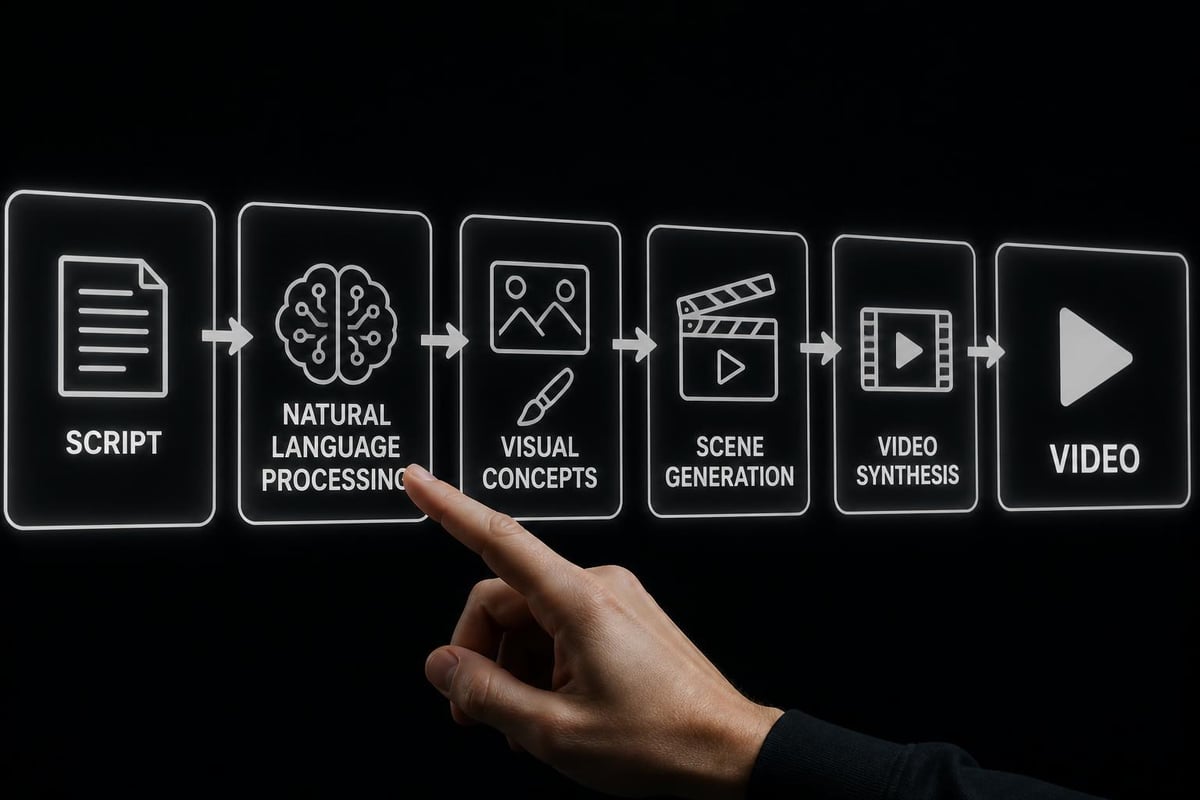
The integration of these components enables marketers to focus on strategic messaging while the AI handles execution. This shift allows for rapid iteration and testing, which is essential in performance marketing where finding winning creatives quickly directly impacts campaign ROI.
Applications in Modern Advertising
Script to video AI has found particularly strong adoption in digital advertising, where volume and variety determine success. Performance marketers need to test dozens of creative variations to identify top performers, making manual production impractical.
User-Generated Content Style Ads
The most compelling application involves creating authentic-looking user-generated content without actual users. These UGC-style ads consistently outperform polished corporate videos because they feel native to social media platforms where consumers spend their time.
Brands can now write scripts mimicking genuine customer testimonials or product demonstrations and have AI generate realistic videos featuring virtual creators. These ads maintain the authenticity audiences crave while giving marketers complete control over messaging, timing, and brand compliance.
| Production Method | Time to Create | Cost per Video | Testing Flexibility | Authenticity Level |
|---|---|---|---|---|
| Traditional Crew | 2-4 weeks | $5,000-$50,000 | Low (expensive iterations) | High (real people) |
| Hired UGC Creators | 1-2 weeks | $500-$2,000 | Medium (creator dependent) | Very High |
| Script to Video AI | Minutes to hours | $10-$100 | Very High (unlimited variations) | High (improving rapidly) |
The efficiency gains become apparent when considering testing requirements. A typical direct-to-consumer brand might need 50-100 creative variations monthly to maintain campaign performance. Traditional methods make this volume financially impossible, while script to video AI makes it routine.
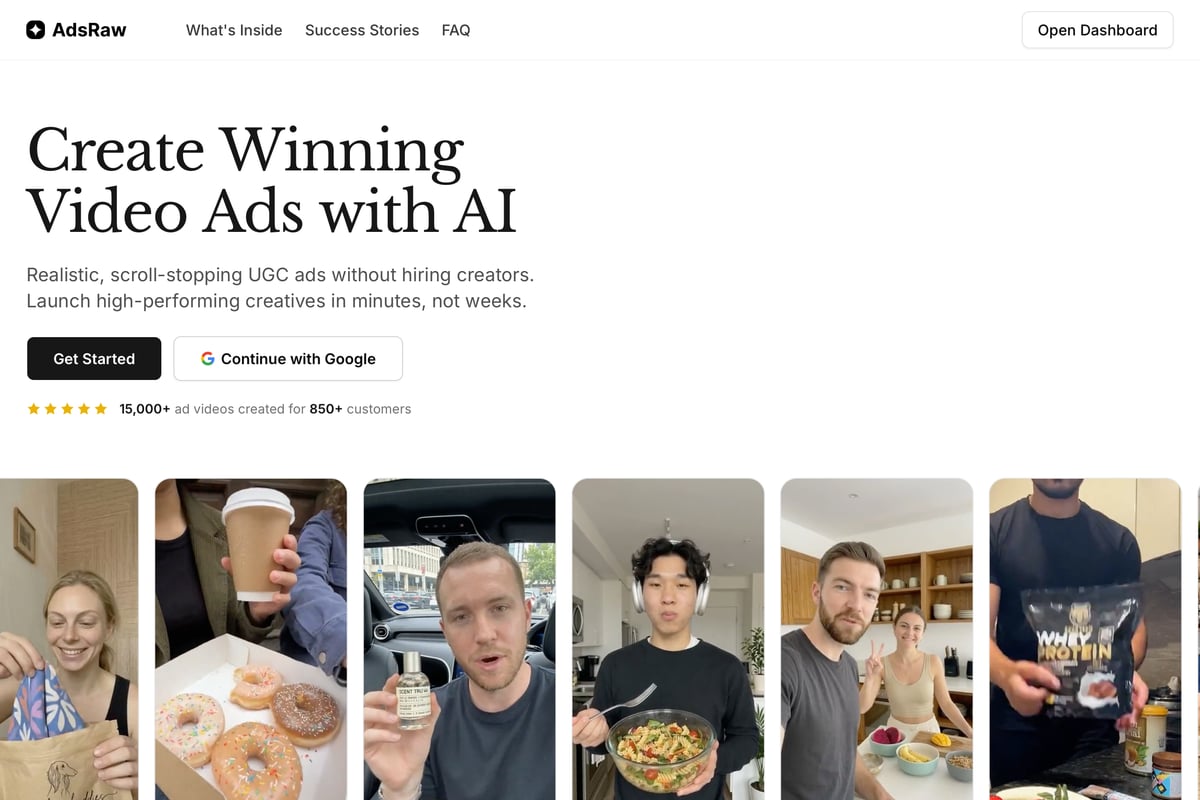
Platforms like AdsRaw have streamlined this process specifically for advertisers, allowing businesses to generate realistic UGC-style video ads from scripts in minutes. This approach eliminates creator coordination while maintaining the authentic feel that drives social media engagement.
Workflow Integration and Best Practices
Implementing script to video AI effectively requires understanding both the technology's capabilities and its limitations. Successful users develop workflows that leverage AI strengths while maintaining human oversight where it matters most.
Script Development for AI Optimization
Writing for AI differs from traditional scriptwriting. The technology performs best with clear, structured narratives that include specific visual cues and emotional markers.
Effective AI script components include:
- Clear speaker identification - Specify who delivers each line
- Visual directions - Note important on-screen elements or actions
- Pacing markers - Indicate pauses, emphasis, or tempo changes
- Emotional context - Describe the intended mood or feeling
- Brand elements - Reference specific products, logos, or visual assets
Many marketers find success starting with proven script frameworks, then creating variations by adjusting specific elements. This systematic approach to testing aligns perfectly with performance marketing methodologies focused on incremental optimization.
Quality Control and Human Review
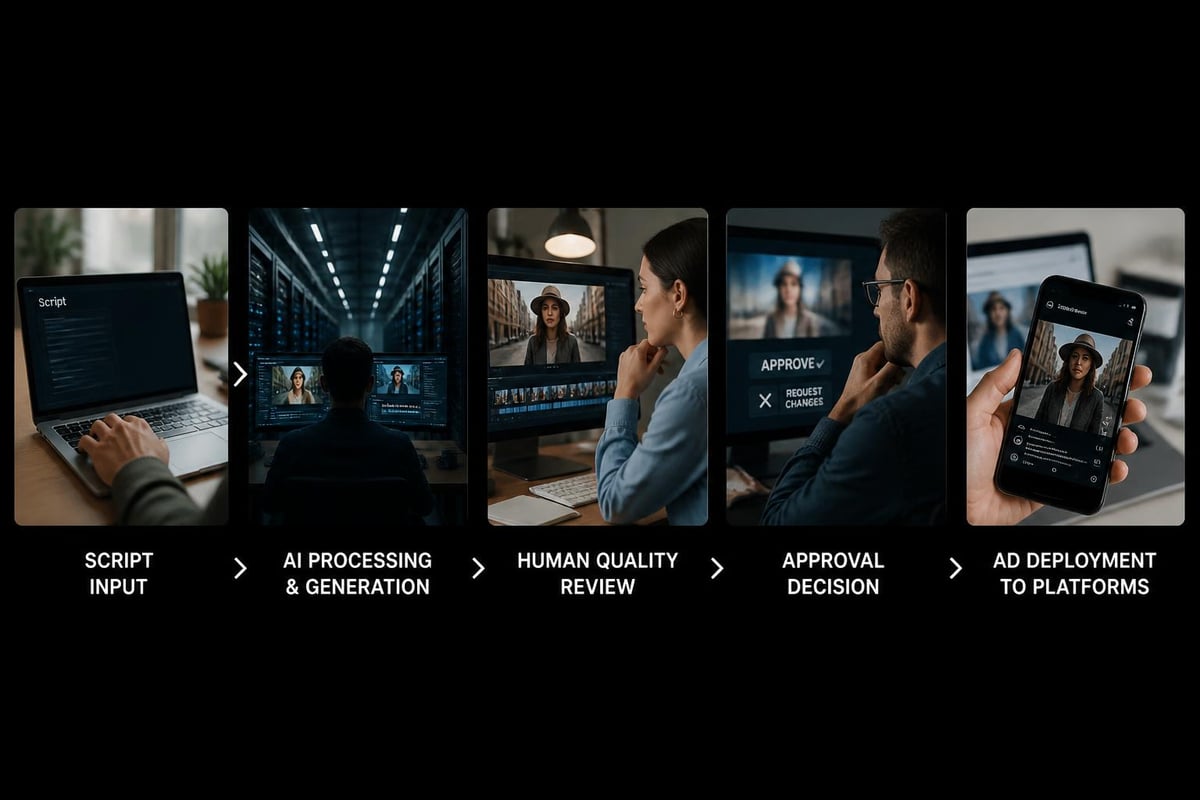
While script to video AI automates production, human judgment remains essential for quality assurance. Teams should establish review checkpoints that verify:
- Brand message accuracy and compliance
- Visual-audio synchronization quality
- Avatar or voice authenticity levels
- Platform-specific formatting requirements
- Legal and regulatory adherence
The review process typically takes minutes rather than hours, maintaining the speed advantage while ensuring output quality meets brand standards.
Technical Capabilities and Limitations
Understanding what script to video AI can and cannot do helps marketers set realistic expectations and choose appropriate use cases.
Current Strengths
Modern platforms excel at specific video types that align with their training data and architectural design. Short-form content for social media represents the sweet spot where AI capabilities match market demands.
Areas of strong performance:
- Product demonstrations with clear feature explanations
- Testimonial-style videos with direct-to-camera delivery
- Educational content with sequential information presentation
- Announcement videos for launches or promotions
- Comparison videos highlighting differentiating factors
The technology particularly shines when producing volume. Creating 20 variations of a core script takes marginally more time than creating one, enabling exhaustive creative testing previously impossible.
Current Constraints
Despite rapid advancement, script to video AI faces certain limitations that influence how marketers should deploy it.
Complex emotional narratives with subtle character development remain challenging. The technology works best with straightforward messaging where clarity matters more than artistic nuance. Extended videos beyond 60-90 seconds can show consistency issues as the AI struggles to maintain coherent visual threads across longer timelines.
Some industries with strict regulatory requirements need additional caution. Financial services, healthcare, and legal sectors may require enhanced review processes to ensure AI-generated content meets compliance standards.
Platform Selection and Evaluation Criteria
The script to video AI market includes dozens of platforms with varying capabilities, pricing models, and target audiences. Selecting the right solution requires evaluating several key dimensions.
Essential Features for Marketing Teams
Advertisers need specific functionality that general-purpose video generators may lack:
| Feature Category | Must-Have Capabilities | Impact on Ad Performance |
|---|---|---|
| Avatar Quality | Realistic facial expressions and movements | Directly affects viewer trust and engagement |
| Voice Options | Multiple tones, accents, and pacing controls | Enables demographic targeting and brand alignment |
| Brand Customization | Logo placement, color schemes, font control | Maintains visual identity consistency |
| Export Formats | Platform-specific outputs (Facebook, TikTok, YouTube) | Ensures technical optimization for each channel |
| Batch Processing | Simultaneous generation of multiple variants | Accelerates testing velocity |
Integration capabilities matter significantly for teams with existing marketing technology stacks. Platforms that connect with asset management systems, analytics tools, and advertising platforms reduce manual workflow steps.
Cost Considerations
Pricing models vary widely across script to video AI platforms. Understanding total cost of ownership requires looking beyond headline subscription rates.
Some platforms charge per video generated, which can become expensive at scale. Others offer unlimited generation within subscription tiers, making them more economical for high-volume testing. Consider also the time savings translated to personnel costs when evaluating true ROI.
Advanced Techniques for Performance Marketers
Sophisticated users develop specialized approaches that maximize script to video AI value for paid advertising campaigns.
Systematic Creative Testing Frameworks
The ability to generate videos rapidly enables structured experimentation that identifies winning formulas. Performance marketers develop testing matrices that isolate specific variables:
Common testing dimensions include:
- Hook variations - Testing different opening three seconds
- Benefit sequencing - Reordering key value propositions
- Call-to-action phrasing - Comparing urgency levels and specific wording
- Visual styling - Testing background environments or on-screen graphics
- Video length - Comparing 15, 30, and 60-second versions
Tools like Google Vids with AI voiceovers demonstrate how mainstream platforms are adopting these capabilities, making the technology increasingly accessible.
By testing systematically and analyzing results through advertising platform analytics, teams identify patterns in what drives performance within their specific audience segments.
Platform-Specific Optimization
Each social and advertising platform has unique characteristics that affect video performance. Script to video AI allows rapid creation of platform-optimized versions from a single core script.
For example, TikTok audiences respond to authentic, casual delivery styles, while LinkedIn users prefer more professional presentations. Rather than choosing one approach, marketers can generate both variations and deploy each where most effective. Recent developments like YouTube Shorts' integration with AI video generation show how platforms themselves are embracing these technologies.
Emerging Trends and Future Developments
The script to video AI field continues evolving rapidly, with several trends shaping its trajectory.
Improved Realism and Authenticity
Current generation models already produce surprisingly realistic outputs, but upcoming improvements focus on subtle authenticity markers that separate AI from human-created content. Facial micro-expressions, natural hand gestures, and environmental interactions all contribute to viewer perception of authenticity.
Research into agentic frameworks for cinematic video generation addresses the semantic gap between creative ideas and their execution, suggesting future systems will better interpret creative intent from scripts.
Longer-Form Content Capabilities
While current script to video AI excels at short clips, expanding to longer formats unlocks new use cases. Educational content, product tutorials, and brand storytelling all benefit from extended timelines.
OmniScript's approach to long-form narrative comprehension demonstrates technical pathways toward coherent extended videos, though practical marketing applications remain focused on shorter formats for now.
Interactive and Personalized Video
The next frontier involves dynamically personalizing video content for individual viewers. Imagine scripts that adapt based on viewer demographics, previous interactions, or real-time context, with AI generating custom videos on-demand.
This capability would revolutionize programmatic advertising by enabling truly one-to-one video communication at scale, though technical and privacy considerations must be addressed first.
Integration with Broader Marketing Strategies
Script to video AI delivers maximum value when integrated thoughtfully into comprehensive marketing strategies rather than used in isolation.
Content Repurposing Workflows
Many marketing teams already produce written content like blog posts, case studies, and email campaigns. Script to video AI enables efficient repurposing of this material into video formats.
Tools like Argil demonstrate PDF-to-video conversion, showing how existing content assets can gain new life across video channels. This multi-format approach ensures consistent messaging while maximizing content investment ROI.
Creating a systematic repurposing workflow involves:
- Identifying high-performing written content through analytics
- Extracting key points suitable for video format
- Developing platform-specific script adaptations
- Generating video variants using script to video AI
- Publishing across appropriate channels with tracking
- Analyzing performance to inform future repurposing decisions
Cross-Channel Campaign Coordination
Video content created through script to video AI should integrate with broader campaign messaging across all touchpoints. The speed of AI generation enables rapid campaign launches while maintaining message consistency.
For product launches, marketing teams can develop a core narrative, then use script to video AI to create:
- Social media teasers and announcements
- Paid advertising variants for different platforms
- Email video embeds for announcement campaigns
- Website hero section videos
- Retargeting ads for different audience segments
This coordinated approach amplifies campaign impact while the production speed allows last-minute adjustments based on early performance signals.
Measuring Success and ROI
Implementing script to video AI requires clear metrics that demonstrate business impact beyond just production efficiency.
Key Performance Indicators
For advertising applications, standard video metrics apply but should be compared against previous production methods to assess true value:
Primary metrics include:
- Cost per video produced - Track full-burden costs including tool subscriptions and time
- Production velocity - Measure videos created per week or month
- Testing throughput - Count creative variations tested in campaigns
- Engagement rates - Monitor view-through rates, click-through rates, and interaction metrics
- Conversion performance - Track ultimate business outcomes like purchases or leads
- Return on ad spend - Calculate revenue generated relative to advertising investment
Teams can explore additional insights through resources like the AdsRaw blog, which covers performance marketing strategies and creative testing methodologies.
Calculating Total Value
True ROI extends beyond direct cost savings. Consider time-to-market advantages, opportunity costs of slower production methods, and competitive positioning benefits from superior testing velocity.
A brand that identifies winning creative concepts three weeks faster than competitors gains significant market advantages, even if absolute production costs are similar. This strategic timing value can exceed pure cost savings.
Practical Implementation Guide
Organizations ready to adopt script to video AI should follow a structured implementation approach that minimizes risk while building internal capabilities.
Pilot Program Design
Recommended launch sequence:
- Select initial use case - Choose high-volume, lower-risk application
- Evaluate platforms - Test 2-3 solutions with trial accounts
- Develop script templates - Create reusable frameworks for common needs
- Train core team - Build expertise with dedicated users
- Run parallel testing - Compare AI outputs against traditional methods
- Measure and iterate - Track defined KPIs and optimize workflows
- Scale gradually - Expand to additional use cases as confidence grows
Starting small allows teams to develop expertise and prove value before large commitments. Many organizations begin with social media content where production volumes are high and risk tolerance is greater.
Team Skill Development
While script to video AI reduces technical barriers, teams still benefit from developing specific competencies:
- Scriptwriting for AI - Understanding how to structure prompts effectively
- Platform expertise - Knowing each tool's strengths and optimal use cases
- Quality assessment - Recognizing when output meets brand standards
- Testing methodology - Designing valid creative experiments
- Performance analysis - Interpreting results to guide future decisions
Many platforms like Dream Machine offer tutorials and best practices that accelerate learning, helping teams become proficient quickly.
Industry-Specific Applications
Different sectors find unique value in script to video AI based on their specific marketing challenges and content requirements.
E-commerce and Direct-to-Consumer Brands
E-commerce businesses face constant pressure to produce fresh creative content that stands out in crowded social feeds. Product catalogs with hundreds or thousands of SKUs make individual video creation economically impossible through traditional means.
Script to video AI enables product-specific videos at scale. A brand can develop template scripts highlighting key features, benefits, and social proof, then generate variants for each product line. This approach transforms product video from occasional hero content to standard for the entire catalog.
B2B and Professional Services
Business-to-business marketers traditionally favor written content but increasingly recognize video's effectiveness for engagement and conversion. Script to video AI removes production barriers that previously kept B2B brands from video strategies.
Thought leadership content, educational resources, and case study presentations all adapt well to AI video generation. The professional, polished aesthetic suits corporate audiences while the efficiency enables consistent content calendars.
Agencies and Content Creators
Marketing agencies serving multiple clients need flexible production capabilities that scale across varying needs and budgets. Script to video AI provides this scalability while maintaining creative control.
Agencies can offer video services to smaller clients previously unable to afford traditional production, expanding service offerings and revenue opportunities. The technology also accelerates campaign launches for all clients, improving service delivery and satisfaction.
Script to video AI has fundamentally transformed how brands approach video advertising, enabling rapid creation of authentic, high-performing content without traditional production constraints. The technology empowers marketing teams to test extensively, optimize continuously, and compete effectively in video-first digital channels. If you're ready to accelerate your ad creative production and discover winning formulas faster, AdsRaw provides the platform to generate realistic UGC-style video ads in minutes, helping you test more concepts and scale what works without the complexity of hiring creators.