
Create Ads with AI: The Complete Guide for 2026

Modest Mitkus
May 12, 2026
The advertising landscape has shifted dramatically. What once required weeks of coordination between creative teams, photographers, videographers, and editors can now happen in minutes. The ability to create ads with AI has fundamentally changed how brands approach content production, testing, and optimization. Whether you're running a DTC brand, managing campaigns for clients, or building an ecommerce empire, artificial intelligence is no longer a nice-to-have. It's become the competitive edge that separates brands scaling profitably from those burning cash on underperforming creative.
The New Reality of Ad Creation
Traditional ad production follows a predictable pattern: brief the creative team, wait for concepts, approve direction, schedule shoots, wait for editing, review cuts, request revisions, and finally launch. The timeline stretches across weeks or months, and costs pile up quickly.
AI flips this model entirely.
When you create ads with AI, you're working at a fundamentally different pace. Need 20 variations of a product demo? Generate them in an afternoon. Want to test different hooks across demographics? Spin up versions in minutes. Discovered a winning angle and need more creative in that direction? Done before lunch.
This speed advantage compounds over time. Brands using AI in advertising can run more tests, gather more data, and optimize faster than competitors stuck in traditional production cycles.
What AI Actually Does for Advertisers
The term "AI advertising" covers multiple capabilities:
- Creative generation: Producing images, video, and copy from scratch
- Asset modification: Changing backgrounds, models, or product variations
- Performance prediction: Analyzing which creative elements will likely perform best
- Audience targeting: Identifying optimal viewer segments for specific creative
- Budget optimization: Allocating spend across campaigns based on real-time performance
Each capability solves specific bottlenecks in the advertising workflow. The most immediate impact? Eliminating production delays that previously killed campaign momentum.
How Brands Create Ads with AI Today
The practical application varies by brand size, product type, and marketing maturity. But certain patterns emerge across successful implementations.
The Testing-First Approach
Performance marketers discovered something powerful: when you can create ads with AI affordably, you can test relentlessly. Instead of committing thousands to produce one "perfect" ad, they generate dozens of variations and let performance data reveal winners.
This methodology fundamentally changes decision-making. Rather than debating which creative direction to pursue, you test them all. The market tells you what works.
Typical testing workflow:
- Generate 15-20 ad variations exploring different angles
- Launch with minimal budget across each variation
- Kill bottom 80% after collecting initial performance data
- Scale spend on top performers
- Generate new variations based on winning elements
- Repeat cycle weekly
Brands following this pattern often discover their best-performing creative contradicts what they expected. The UGC-style video they almost didn't test outperforms the polished product showcase by 300%. The quirky hook beats the safe introduction.
You only learn this through volume testing, which becomes economically viable when you create ads with AI.
The Production Replacement Model
Other brands use AI to replace specific production tasks that previously required external resources. Product photography represents the clearest example.
An accessories brand previously spent $3,000 monthly on model shoots. They needed fresh content showing jewelry on different people, but booking models, photographers, and studios created logistical nightmares.
By switching to AI-generated product imagery, they eliminated the entire production chain. Upload product images, select AI models, generate lifestyle shots. The AI product image generator handles what previously required coordinating five people's schedules.
| Traditional Production | AI Production |
|---|---|
| 2-3 week lead time | Same day delivery |
| $500-1,500 per shoot | $20-50 per batch |
| Limited variations | Unlimited iterations |
| Requires scheduling | On-demand generation |
| Geographic constraints | Location independent |
The cost difference matters, but the flexibility drives even more value. When you can generate new product shots instantly, you adapt to trends faster, test seasonal angles earlier, and respond to performance data immediately.
The Technical Reality: What Works and What Doesn't
Not all AI advertising tools deliver equal results. Understanding current capabilities helps set realistic expectations.
Where AI Excels
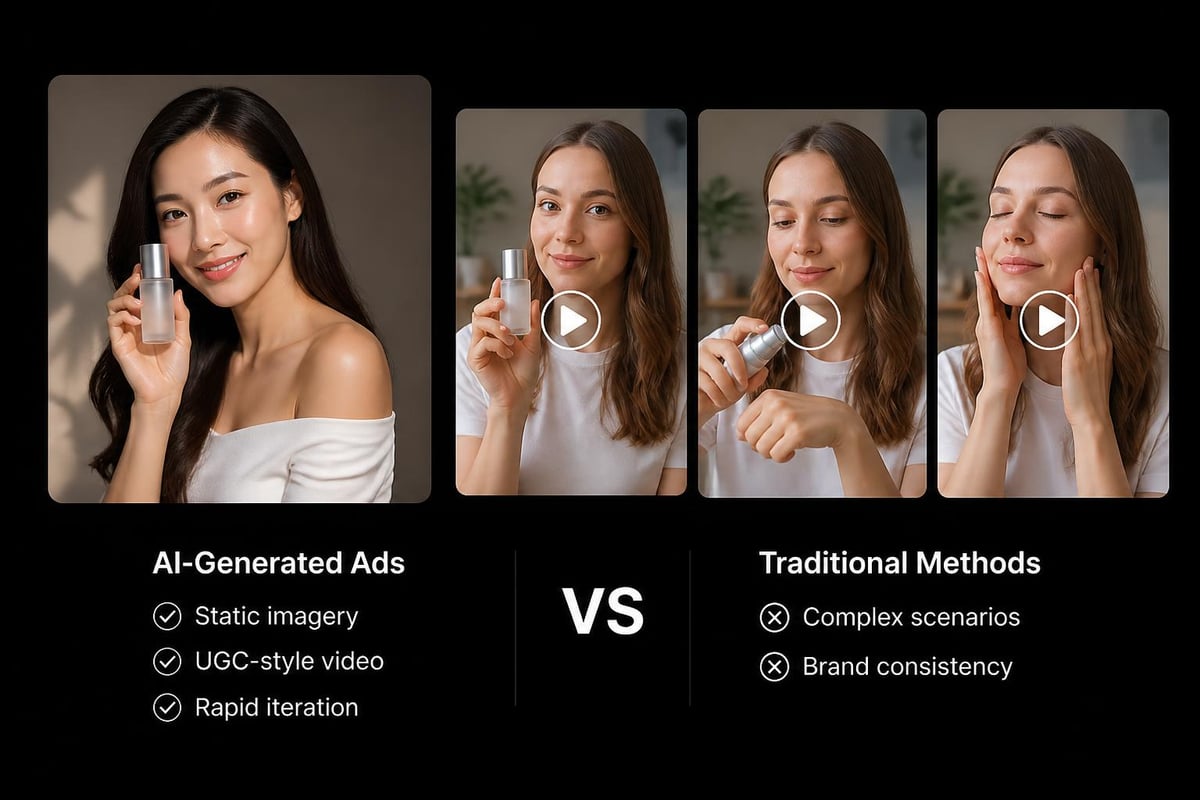
Static product imagery has reached commercial quality. AI-generated product photos are often indistinguishable from traditional photography, especially for packaged goods, accessories, and apparel.
UGC-style video represents another strength. The slightly imperfect, authentic feel that makes user-generated content perform well actually plays to AI's current capabilities. When viewers expect raw, unpolished content, AI-generated videos blend seamlessly.
Rapid iteration remains the killer application. Even when individual AI-generated assets match 90% of traditional quality, the ability to produce 10x the volume in 10% of the time creates superior outcomes.
Current Limitations
Complex scenarios still challenge AI systems. Multi-person interactions, intricate product demonstrations, or highly specific creative requirements may require human production.
Brand consistency across large asset libraries demands careful prompt engineering and quality control. While you can create ads with AI efficiently, maintaining visual coherence across thousands of assets requires systematic approaches.
Legal and rights considerations remain evolving. Understanding AI's role in modern advertising includes navigating intellectual property questions, disclosure requirements, and platform policies around AI-generated content.
Building Your AI Advertising Stack
Successfully implementing AI advertising requires more than subscribing to tools. You're building a new creative production system.
The Core Components
Your stack needs to address different content needs:
- Static image generation for social feeds, display ads, and product pages
- Video production for TikTok, Instagram Reels, YouTube, and connected TV
- Copy generation for headlines, descriptions, and calls-to-action
- Performance analytics to identify what's working
Many brands start with one component and expand as they prove ROI. Beginning with video often delivers the highest impact since traditional video production costs most and takes longest.
Integration with Existing Workflows
The smoothest AI implementations complement rather than replace existing processes. Your creative team's role shifts from production to direction and curation.
Instead of creating every asset manually, they:
- Define creative strategies and test hypotheses
- Generate AI content based on strategic direction
- Curate best-performing outputs
- Refine and iterate based on performance data
- Maintain brand standards across AI-generated content
This evolution typically increases output while reducing team stress. Creative professionals spend more time on high-value strategic work and less time on repetitive production tasks.
Optimizing Performance When You Create Ads with AI
Generating content quickly only matters if it drives results. Top-performing brands follow specific optimization patterns.
Volume Testing with Structure
Random testing wastes resources. Structured experimentation reveals insights.
Effective testing framework:
- Week 1: Test 5 different hooks with same product showcase
- Week 2: Test 3 different CTA styles with winning hook
- Week 3: Test 4 background/setting variations with winning elements
- Week 4: Test 5 new hooks incorporating learnings from previous tests
This systematic approach builds knowledge about what resonates with your audience. Each testing cycle informs the next, creating compounding improvements in creative performance.
Data-Driven Creative Decisions
When you can create ads with AI affordably, you stop guessing and start measuring. Every creative decision becomes a hypothesis you can test.
Did that testimonial-style video outperform the product demo? Generate 10 more testimonial variations. Is the lifestyle background driving better engagement than the white background? Test more lifestyle settings.
The fastest-growing brands treat creative as a continuous optimization process rather than periodic campaigns. They're running creative tests the way performance marketers run audience tests, constantly refining what works.
For brands producing UGC-style content, tools like the AI UGC video generator enable this testing velocity by letting you create realistic video ads without hiring creators for every variation.
Platform-Specific Optimization
Each advertising platform rewards different creative elements. AI's production speed lets you customize content for platform-specific performance.
TikTok ads perform best with:
- Native, authentic feel
- Hook in first 1.5 seconds
- Vertical 9:16 format
- Direct address to viewer
Facebook feed ads convert better with:
- Clear product benefit visible immediately
- Square or vertical format
- Subtitles (most viewers watch without sound)
- Clear CTA in first 3 seconds
YouTube pre-roll requires:
- Strong pattern interrupt within 5 seconds
- Longer storytelling arc (15-30 seconds)
- Horizontal format
- Brand recall elements
Rather than creating one video and adapting it everywhere, create platform-native versions. The marginal cost when you create ads with AI approaches zero, so optimization becomes purely about performance.
The Economics of AI Advertising
Cost analysis reveals why brands are shifting budgets toward AI creation.
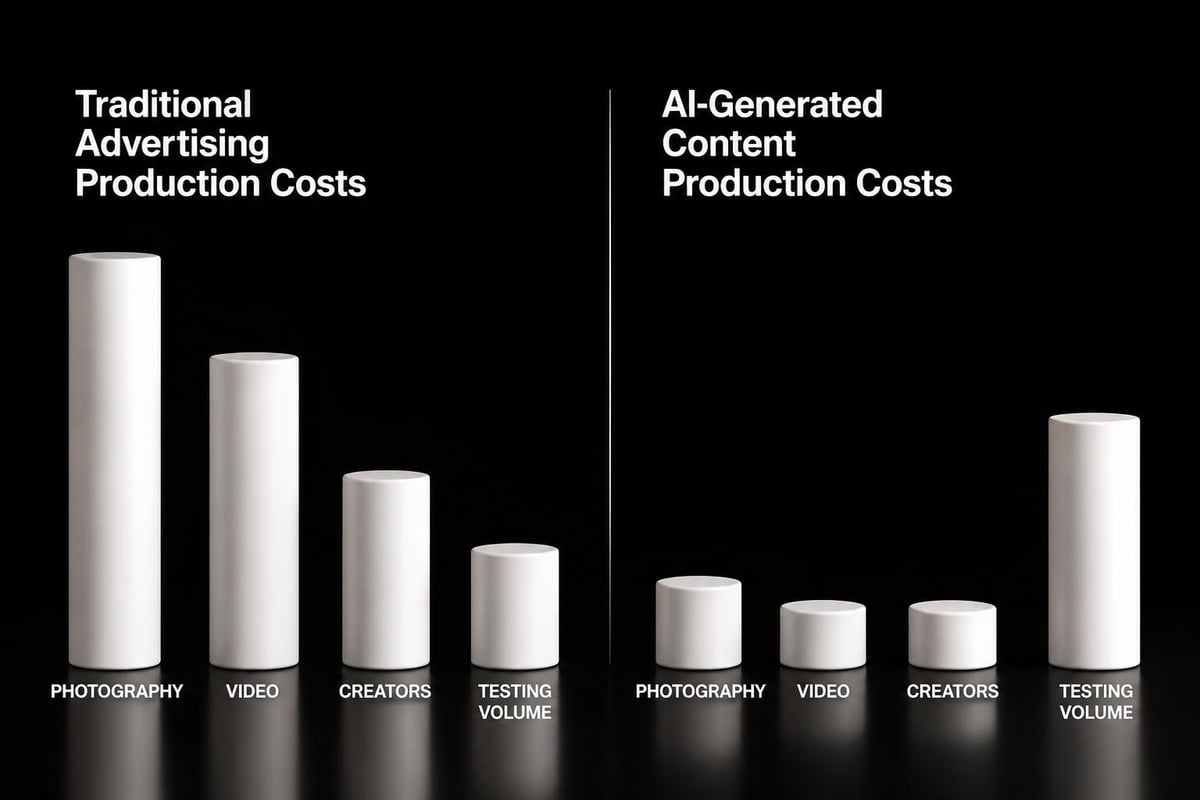
Traditional Production Costs
A typical DTC brand running performance marketing might spend:
- Product photography: $2,000-5,000 monthly
- Video production: $5,000-15,000 per campaign
- Creator partnerships: $500-2,000 per deliverable
- Agency creative services: $3,000-10,000 monthly retainer
Annual creative costs easily reach $100,000-250,000, and that's before media spend.
AI Production Economics
Comparable AI-generated content costs:
- Image generation: $50-200 monthly (unlimited variations)
- Video production: $100-500 monthly (dozens of variations)
- Testing capacity: 10-50x volume at similar cost
The cost reduction is substantial, but the real value comes from testing capacity. Spending $500 to test 30 video variations teaches you more than spending $15,000 to produce three "perfect" videos.
You discover what actually works rather than defending creative decisions made in conference rooms.
Navigating AI Advertising Challenges
Implementation isn't without obstacles. Understanding common challenges helps you plan around them.
Quality Control at Scale
When you can create ads with AI in minutes, quality control becomes the constraint. Generating 100 ad variations means reviewing 100 assets before launch.
Effective QC processes:
- Establish clear brand guidelines and visual standards
- Use batch generation with consistent prompts
- Review in stages (eliminate obvious failures immediately, deeper review for finalists)
- A/B test borderline cases rather than debating subjectively
Most brands find their QC process accelerates after the first month as they develop faster evaluation skills and better prompts.
Platform Policy Compliance
Advertising platforms continue updating policies around AI-generated content. Some require disclosure, others ban certain applications entirely.
Stay current on:
- Meta's AI disclosure requirements for ads using AI-generated people or events
- TikTok's branded content policies and AI usage guidelines
- Google's advertiser identity requirements and synthetic media policies
The landscape evolves rapidly, making ongoing education essential. Resources like TV Technology's coverage of AI advertising platforms help marketers stay informed about industry developments.
Maintaining Authenticity
Audiences value genuine connection. As more brands create ads with AI, authenticity becomes a differentiator rather than a given.
The solution isn't avoiding AI. It's using AI to scale authentic communication rather than replacing it with generic content.
Authenticity preservation strategies:
- Base AI-generated content on real customer feedback and reviews
- Use AI to create more variations of genuinely resonant messages
- Combine AI-generated visuals with authentic customer testimonials
- Test content with actual customers before scaling spend
The brands winning with AI advertising aren't the ones generating the most content. They're the ones generating the most relevant, resonant content their audience actually cares about.
Advanced Applications and Future Developments
Early adopters are already exploring next-generation applications.
Personalized Creative at Scale
Imagine serving different ad creative to every viewer based on their demonstrated preferences, browsing history, and demographic profile. Traditional production makes this impossible. AI makes it inevitable.
Brands are beginning to test hyper-personalized creative where product showcases, messaging, and even AI presenters adjust based on viewer characteristics. Academic research on personalized AI-generated advertisements suggests this approach can significantly improve conversion rates.
Real-Time Creative Optimization
Rather than testing creative weekly or monthly, advanced implementations adjust creative elements in real-time based on performance signals.
If engagement drops on your current video ad, the system automatically generates and tests new variations. When it identifies a winner, it scales spend accordingly without human intervention.
This closed-loop optimization represents where AI advertising is heading: continuous autonomous improvement guided by performance data.
Cross-Platform Creative Orchestration
The most sophisticated implementations coordinate creative across every touchpoint. Your Instagram ad, retargeting display ad, email creative, and landing page all feature consistent but platform-optimized messaging and visuals, all generated from a single AI workflow.
This level of coordination previously required large creative teams. AI systems can now maintain brand consistency while optimizing for platform-specific performance across dozens of channels simultaneously.
Getting Started: Your First 30 Days
Moving from traditional to AI-driven advertising feels overwhelming. Break it into manageable phases.
Days 1-7: Assessment and Planning
- Audit current creative production costs and timelines
- Identify biggest production bottlenecks
- Review current best-performing creative for patterns
- Research AI tools matching your specific needs
- Visit AdsRaw pricing to understand platform options
Days 8-14: Initial Testing
- Create your first batch of AI-generated content (start with 5-10 variations)
- Run small test campaigns comparing AI vs. traditional creative
- Document production time and cost differences
- Gather initial performance data
Days 15-23: Optimization and Scaling
- Analyze which AI-generated content performed best
- Generate new variations based on winners
- Increase budget on top performers
- Expand to additional product lines or campaign types
Days 24-30: Process Development
- Document your AI creative workflow
- Train team members on generation and optimization
- Establish quality control standards
- Plan next month's testing roadmap
This measured approach builds confidence and capabilities without overwhelming your team or risking significant budget.
The Competitive Implications
The brands that master AI advertising first build compounding advantages. They learn faster, test more, and optimize continuously while competitors remain stuck in traditional production cycles.
This creates a knowledge gap that widens over time. After six months of testing 30 creative variations weekly, you understand your audience at a depth competitors testing 3 variations monthly can't match.
The data advantage alone justifies adoption, but the cost savings and speed improvements make resistance increasingly difficult to justify.
Understanding how AI is transforming advertising helps contextualize these changes within broader industry trends that aren't reversing.
Making the Strategic Shift
The question isn't whether to create ads with AI. It's how quickly you can implement effectively and how thoroughly you can integrate these capabilities into your marketing operations.
Brands succeeding with AI advertising share common approaches:
- Start small, scale systematically: Test one application thoroughly before expanding
- Measure everything: Track production costs, time savings, and performance metrics
- Iterate relentlessly: Use AI's speed advantage to test and learn continuously
- Maintain quality standards: Volume doesn't excuse poor creative
- Stay platform-compliant: Follow disclosure requirements and advertising policies
The transition from traditional to AI-powered advertising represents a fundamental shift in how brands approach creative production, but the underlying principles remain constant. Great advertising resonates with audiences, communicates clear value, and drives measurable business outcomes.
AI simply removes the production constraints that previously limited how quickly and affordably you could create, test, and optimize toward those outcomes. For more insights and resources on implementing AI advertising strategies, check out the AdsRaw blog.
The brands that recognize this opportunity early and execute systematically will build advantages their competitors spend years trying to match. The tools exist today. The question is whether you'll use them before your competition does.
AI has fundamentally changed what's possible in advertising creation, letting brands test more, learn faster, and scale what works without the traditional constraints of time and budget. If you're ready to move beyond the limitations of traditional production and start generating scroll-stopping UGC-style video ads in minutes instead of weeks, AdsRaw gives you the creative velocity you need to find winning ads faster and scale your campaigns profitably.