
AI Script to Video: Creating High-Converting Ads Instantly

Modest Mitkus
May 17, 2026
Creating video content used to mean hiring actors, booking studios, coordinating shoots, and waiting weeks for final edits. Now? You can transform a simple script into polished video content in minutes. The rise of AI script to video technology has fundamentally changed how businesses approach video marketing, making it possible to test dozens of concepts, hooks, and angles without the traditional production overhead. For performance marketers and DTC brands running ad campaigns, this shift isn't just convenient-it's transformative.
What AI Script to Video Technology Actually Does
When we talk about ai script to video tools, we're describing platforms that convert written text into video footage featuring realistic actors, product showcases, or scenes. You provide the script-what you want someone to say, how you want them to say it, what should happen on screen-and the AI generates the corresponding video content.
The core components include:
- Natural language processing to understand your script's intent and structure
- Text-to-speech synthesis that creates realistic voice performances
- Video generation models that produce visual content matching your description
- Character animation systems that sync lip movements with dialogue
- Scene composition tools that arrange elements according to your vision
The technology has evolved rapidly. Early models struggled with coherent motion and realistic human features. Today's systems can generate footage that viewers genuinely can't distinguish from traditionally filmed content. Researchers have made significant strides in text-to-video synthesis capabilities, enabling longer, higher-quality outputs with smooth transitions.
Why Traditional Video Production Can't Keep Pace
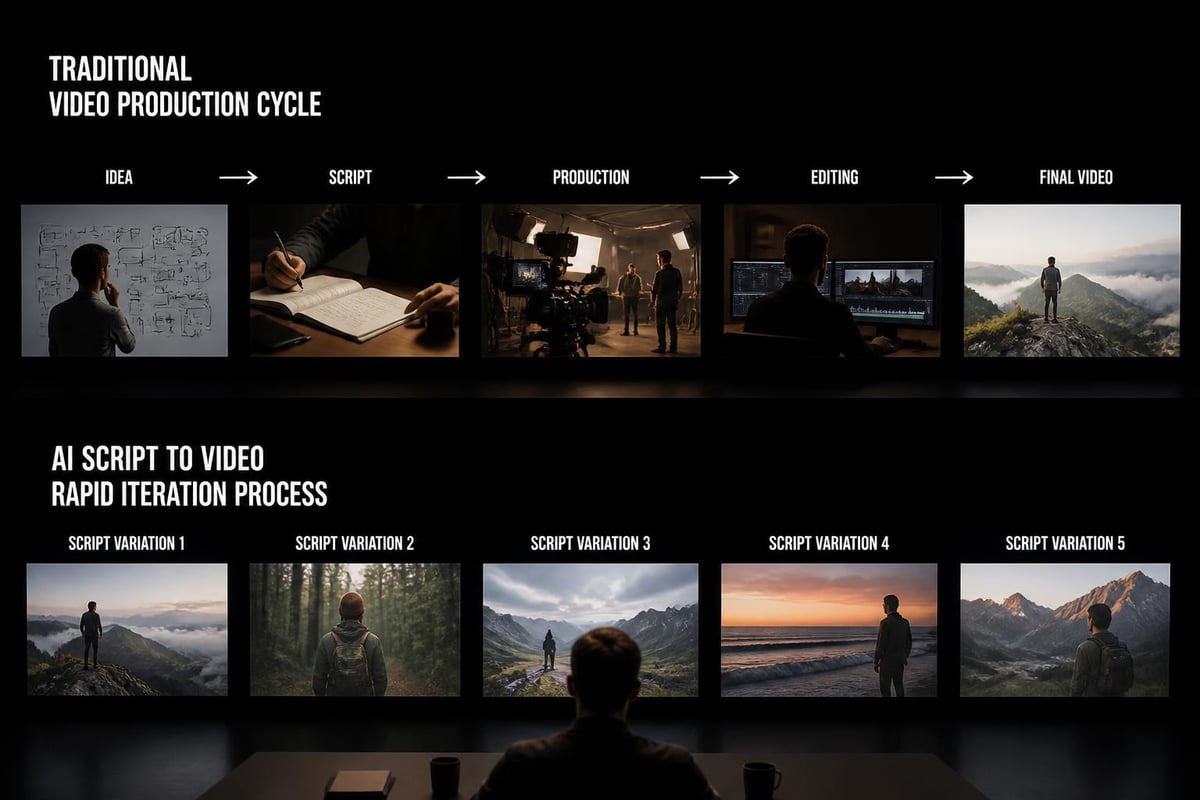
Think about your current video production workflow. You write a script, find a creator or actor, coordinate schedules, film multiple takes, wait for edits, request revisions, and finally receive your video-maybe two weeks later if everything goes smoothly.
What happens when that video doesn't perform? You're back to square one, except now you need a different hook, a different angle, or a completely different approach. Each iteration costs hundreds of dollars and another two-week cycle.
Performance marketing demands speed. The brands winning in 2026 are the ones testing 20, 30, even 50 creative variations to find what actually converts. That's impossible with traditional production timelines and budgets.
How AI Script to Video Fits Into Modern Marketing
The shift to AI-generated video isn't just about cost savings. It fundamentally changes what's possible in your marketing strategy.
Consider these applications:
- Rapid creative testing - Launch 10 different hooks this week, not this quarter
- Personalization at scale - Generate versions tailored to different audience segments
- Multi-platform optimization - Create vertical, square, and horizontal cuts from one script
- Seasonal campaigns - Produce holiday content without advance booking
- Trend response - Jump on viral moments while they're still relevant
The economics make sense too. Traditional UGC creator rates run $300-$500 per video, minimum. For a proper creative test with statistical significance, you might need 15-20 variations. That's $6,000-$10,000 before you've found a single winner.
The UGC Video Revolution
User-generated content style videos consistently outperform polished brand content on social platforms. They feel authentic, trustworthy, and native to the feed. But sourcing real UGC at scale presents challenges. Creators have inconsistent quality, varying delivery times, and limited availability.
This is where ai script to video technology shows its real strength. You can generate UGC-style content that maintains the authentic feel while giving you complete control over messaging, pacing, and positioning. Need that perfect three-second hook? Write it, generate it, test it. The latest AI video generation tools now produce 10-second clips from simple text inputs with remarkable quality.
| Traditional UGC | AI Script to Video |
|---|---|
| 5-10 day turnaround | Minutes |
| $300-500 per video | Fraction of the cost |
| Limited revisions | Unlimited iterations |
| Scheduling challenges | On-demand generation |
| Inconsistent quality | Controlled output |
Writing Scripts That Work With AI Video Generators
Not all scripts translate equally well to AI-generated video. You need to understand the technology's strengths and write accordingly.
Start with clear, specific descriptions. Instead of "Show the product," write "Camera zooms in on the moisturizer bottle sitting on a marble countertop." The more specific your visual direction, the better your output.
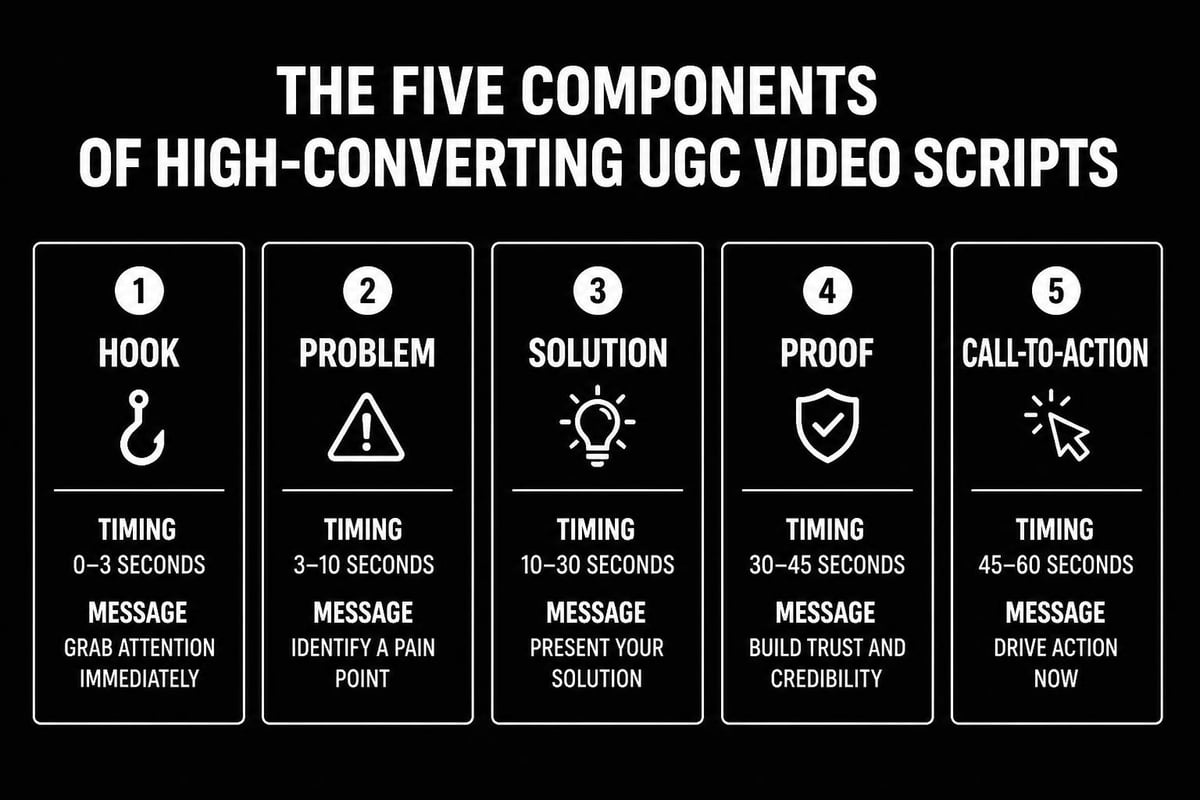
Structure for authenticity. UGC videos that convert typically follow patterns: hook in the first three seconds, problem identification, solution presentation, social proof, and call to action. Your script should hit these beats naturally.
Here's a framework that works:
- Opening hook (0-3 seconds): Stop the scroll with a bold claim or question
- Problem statement (3-8 seconds): Identify the pain point your audience feels
- Solution introduction (8-15 seconds): Present your product as the answer
- Demonstration or proof (15-25 seconds): Show it in action or cite results
- Call to action (25-30 seconds): Tell them exactly what to do next
When you're using ai script to video platforms, think cinematically. Break your script into scenes. Specify camera angles, actor expressions, and visual elements. "Close-up of Sarah's excited face as she holds up the product" gives the AI clear direction.
Testing Hooks at Scale
The hook determines whether anyone watches past frame one. With traditional production, you might test two or three hooks per campaign. With AI script to video technology, you can test twenty.
Write variations that approach the pain point from different angles:
- "Stop wasting money on Facebook ads that don't convert"
- "I spent $10,000 learning this Facebook ads lesson"
- "This Facebook ads mistake killed my ROAS"
- "Why your Facebook ads stopped working in 2026"
Generate a video for each. Run them as identical ad sets. Let the data tell you which hook resonates. Then double down with additional body copy variations using that winning hook.
Choosing the Right AI Script to Video Platform
The market has exploded with options. Comprehensive AI tool reviews cover dozens of platforms, but they're not all built for the same use case.
Evaluate platforms based on:
- Output quality and realism of generated actors
- Script-to-video turnaround time
- Customization options (voice, appearance, settings)
- Video length limitations
- Export formats and resolution options
- Integration with your existing marketing stack
Some platforms excel at educational content with talking head presentations. Others specialize in product demonstrations. For performance marketing and paid social, you need tools optimized for short-form, UGC-style content that converts.
When major companies like Adobe introduce AI editing tools that work from text prompts, you know the technology has matured beyond experimental phase. These aren't novelty features-they're production tools.
What to Look for in Generated Output
Quality varies dramatically between platforms. Here's how to evaluate:
Facial realism: Do the actors look like real people? Check for uncanny valley issues-that subtle wrongness that triggers viewer distrust. Pay special attention to eyes and mouth movements during speech.
Lip sync accuracy: Does the mouth movement match the audio convincingly? Poor sync destroys credibility instantly.
Motion naturalness: Do gestures and movements flow smoothly, or do they have that robotic, interpolated quality?
Lighting and color: Does the footage have natural lighting that matches real camera work, or does it look obviously synthetic?
Background coherence: Do settings remain consistent throughout the video, or do elements shift unnaturally between frames?
For brands running paid ads, especially on platforms like Meta or TikTok, your content needs to blend seamlessly into the feed. Anything that screams "AI-generated" will get scrolled past.
Integrating AI Script to Video Into Your Workflow
You've found the right platform. Now what? The most successful teams build systematic workflows around their AI video generation capabilities.
Start by creating a script library. Document every hook, angle, and message that's worked for your brand. Organize them by product, audience segment, and campaign goal. When you need new creative, you're not starting from scratch-you're remixing proven elements.
Build a testing framework:
- Week 1: Generate 15-20 hook variations from your script library
- Week 2: Launch all variations as separate ad sets with identical targeting
- Week 3: Analyze performance, identify top 3 performers
- Week 4: Generate body copy variations for winning hooks, test again
This continuous testing cycle identifies winners faster while keeping production costs minimal. You're spending money on media testing, not production overhead.
Collaboration Between Teams
AI script to video tools work best when copywriters, media buyers, and creative strategists collaborate closely. Your copywriter understands messaging. Your media buyer knows what's working in the auction. Your strategist sees the bigger picture.
Create a shared workflow:
- Media buyers identify winning visual patterns from current campaigns
- Copywriters develop scripts following those patterns with new angles
- Strategists ensure brand consistency and message hierarchy
- AI generates videos based on approved scripts
- Media buyers launch and monitor performance
- The cycle repeats with data-informed improvements
This collaborative approach means you're not just generating random videos. You're producing strategic assets informed by actual performance data.
Advanced Strategies for Performance Marketers
Once you've mastered basic ai script to video creation, several advanced techniques can multiply your results.
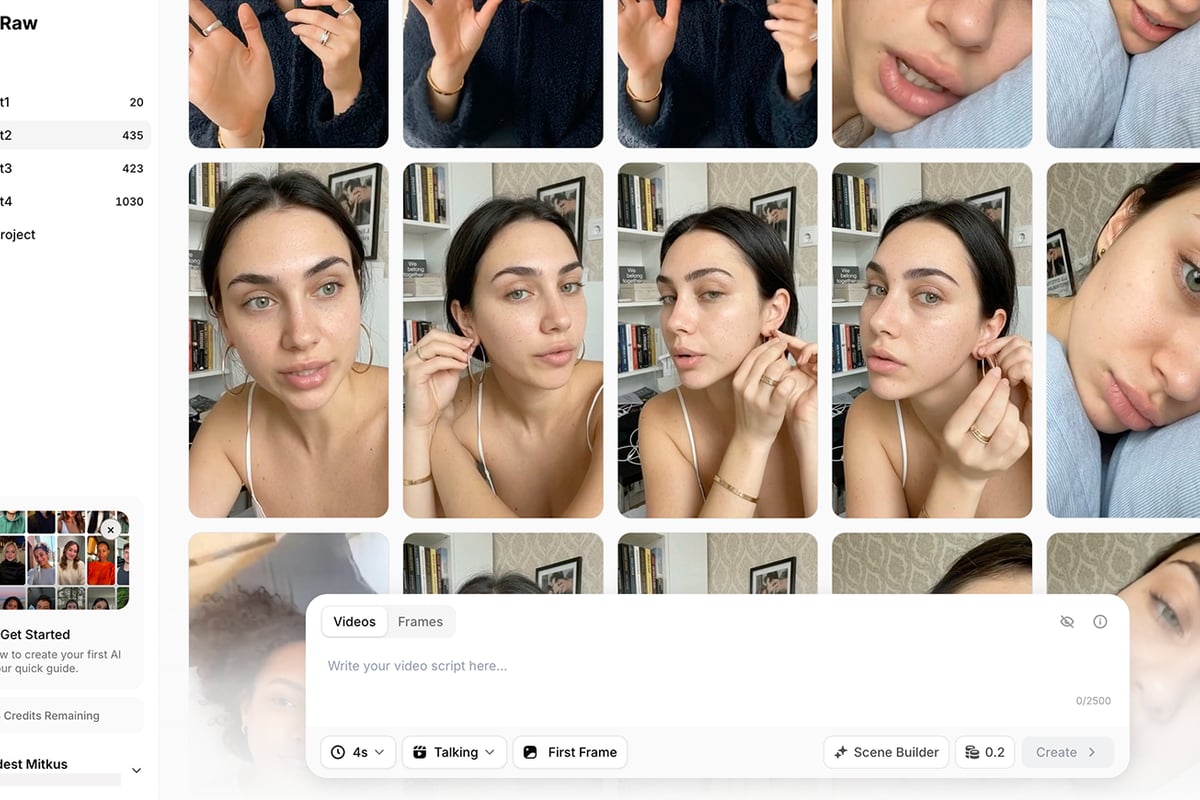
Dynamic product insertion lets you maintain the same actor and script while swapping in different products. Film (or generate) once, use for your entire catalog. This works exceptionally well for supplement brands, skincare lines, or any business with multiple SKUs sharing similar benefits.
Audience-specific customization means generating slight variations for different demographics. The same script, but you modify specific words, cultural references, or visual elements to resonate with particular segments. When OpenAI unveiled Sora, they demonstrated how text descriptions could generate drastically different visual interpretations-that flexibility is what makes audience customization possible.
Sequential storytelling involves creating connected videos that build on each other. Your first ad hooks viewers. Your retargeting ad acknowledges they've seen the first message and advances the narrative. This creates continuity that traditional one-off creator videos can't easily achieve.
A/B Testing Beyond the Hook
Everyone tests hooks. Smart marketers test everything.
Test these elements systematically:
- Actor demographics (age, gender, ethnicity)
- Setting and background (home, office, outdoor, studio)
- Pacing and energy (calm/authoritative vs. excited/enthusiastic)
- Script structure (problem-first vs. solution-first)
- Visual focus (product-centric vs. person-centric)
- Length (15s vs. 30s vs. 60s)
Each variable impacts performance differently across audiences and platforms. The only way to know what works for your specific offer is to test. AI script to video technology makes this testing economically viable.
| Test Variable | Traditional Cost | AI Script to Video Cost | Time Saved |
|---|---|---|---|
| 5 hook variations | $1,500-2,500 | Minimal | 2-3 weeks |
| 3 actor demographics | $900-1,500 | Minimal | 1-2 weeks |
| 4 setting options | $1,200-2,000 | Minimal | 2-4 weeks |
| Total testing | $3,600-6,000 | Fraction of cost | 5-9 weeks |
Technical Considerations and Best Practices
Understanding the technology's limitations helps you work within its strengths. Current AI script to video models excel at certain scenarios and struggle with others.
Where the technology shines:
- Direct-to-camera testimonials and presentations
- Product demonstrations with simple interactions
- Static or minimally changing backgrounds
- Clear, well-lit scenarios
- Videos under 60 seconds
Where challenges remain:
- Complex multi-person interactions
- Rapid camera movement or action sequences
- Highly detailed product close-ups requiring perfect accuracy
- Extended videos maintaining perfect consistency
- Scenarios requiring precise brand color matching
Work within these parameters, and your output will be indistinguishable from traditionally produced content. Push beyond them, and you'll get results that feel "off" to viewers.
File Management and Asset Organization
As you scale AI video production, organization becomes critical. Generate fifty videos this month, and you need systems to track what's what.
Implement a naming convention that captures essential details: Product_Hook_Actor_Date_Version.mp4. Create folders organized by campaign, product line, or testing cycle. Tag assets with performance data once campaigns run.
Consider building a creative asset database. When a hook works for Product A, you want to quickly find and adapt it for Product B. When an actor's delivery style converts well, you want to use that same style for new scripts.
The Future of AI Script to Video Technology
The technology improves monthly. Models released in early 2026 already show dramatic quality improvements over 2025 versions. Research continues advancing, with papers exploring variable-length video generation from text descriptions and other innovations.
Emerging capabilities to watch:
- Real-time generation enabling live customization
- Improved consistency for longer-form content
- Better integration with traditional footage
- Enhanced control over specific visual elements
- Multi-language support with natural localization
We're approaching a point where the question isn't "Can AI generate this video?" but rather "Which AI tool generates it best for my specific use case?" For marketers focused on discovering the latest AI tools, staying current with platform capabilities provides competitive advantages.
The brands that win in this environment will be those treating AI script to video as a strategic capability, not just a cost-saving measure. It's about velocity, testing sophistication, and the ability to find winning creative before your competitors do.
Privacy, Ethics, and Platform Compliance
Using AI-generated content for advertising raises questions about disclosure, authenticity, and platform policies. Major ad platforms are still developing their specific requirements, but general principles apply.
Be transparent when required. Some platforms may require disclosure that content is AI-generated. Even when not required, consider your brand values and audience expectations.
Respect personality rights. Don't generate videos impersonating real people without permission. Use generic AI actors or clearly fictional characters.
Follow platform guidelines. Meta, Google, TikTok, and other ad platforms update their policies regarding AI content regularly. Stay informed to avoid disapproved ads or account issues.
Maintain brand integrity. Just because you can generate unlimited variations doesn't mean you should abandon brand standards. Consistency across touchpoints still matters.
The technology enables rapid creation, but strategic thinking still determines what's worth creating. Use ai script to video tools to amplify your best ideas, not replace strategic creative development.
Measuring Success and Optimizing Performance
AI-generated videos should be evaluated by the same metrics as any creative asset. Click-through rate, view-through rate, cost per acquisition, return on ad spend-these fundamentals don't change.
What does change is your testing methodology. With traditional production, you might test five creative variations per quarter. Limited sample size means limited learning. With AI script to video generation, you can test fifty variations per month. That volume enables statistical significance and genuine insight.
Track performance at the element level:
- Which hooks drive the highest CTR?
- Which actor demographics generate the lowest CPA?
- Which settings correlate with highest engagement?
- Which script structures lead to best ROAS?
Build a performance database linking creative elements to outcomes. Over time, you develop a playbook of what works for your specific audience and offer. New campaigns can leverage this accumulated knowledge, starting from an informed position rather than guessing.
The transformation from script to video used to require weeks and significant budgets. Today's ai script to video technology compresses that timeline to minutes while dramatically reducing costs, fundamentally changing what's possible for brands running performance marketing campaigns. If you're ready to scale your creative testing and find winning ads faster than your competition, AdsRaw delivers realistic, scroll-stopping UGC ads without the traditional production overhead, enabling you to launch high-performing video creatives in minutes and iterate based on real performance data.